
Modern agriculture in the United States is no longer driven solely by tractors, irrigation pipes, and seasonal experience. Large-scale farming operations now rely heavily on machine learning systems, precision agriculture software, automated equipment, and predictive analytics to improve crop yields, reduce operational waste, and manage increasingly difficult climate conditions.
Data from the United States Department of Agriculture (USDA) Economic Research Service indicates that precision agriculture adoption has surpassed 50% across medium and large-scale crop farms for technologies like auto-guidance and yield mapping. This structural transition directly impacts net farm income by shifting operations away from traditional protective spraying toward proactive, square-meter management.
As production costs continue rising across fertilizer, fuel, labor, and water usage, farms are shifting toward data-driven agricultural management. Machine learning has become one of the most important technologies behind that transformation because it allows agricultural systems to process massive amounts of field data faster than humans can manually analyze it.
This comprehensive guide covers how machine learning algorithms decode complex field variables, the specific software tools operating on modern equipment, and the metric-driven outcomes reshaping food production systems.
What Machine Learning Actually Means in Agriculture
Machine learning in agriculture refers to computer systems that analyze agricultural data patterns and continuously improve predictions or operational decisions without requiring constant manual programming. Instead of relying only on farmer observation or historical assumptions, these systems process disparate variables to create actionable execution maps.
To construct a reliable field model, computational infrastructure ingests specific real-time data feeds:
- Satellite Imagery: Multi-spectral data tracking normalized difference vegetation index (NDVI) shifts.
- Soil Sensor Readings: Real-time data streams reporting localized moisture tension, electrical conductivity, and nitrogen-phosphorus-potassium (NPK) levels.
- Weather Conditions: Hyper-local barometric, temperature, wind speed, and humidity historical data.
- Drone Footage: Ultra-high-resolution aerial photography capturing individual leaf anomalies.
- Equipment Performance: Real-time fuel burn rates, torque adjustments, and wheel-slip telemetry from connected machinery.
The system then identifies patterns humans may miss and recommends operational adjustments. This process is commonly called precision agriculture or smart farming. By compiling these variables, predictive engines determine exactly which field zones need more irrigation, predict fungal disease before visible damage appears, optimize fertilizer quantities per acre, and forecast yield reductions caused by drought stress.
Why U.S. Farms Are Adopting Machine Learning
Several structural pressures are pushing American farms toward agricultural automation and machine learning systems. Operating margins within the agricultural sector have become razor-thin, leaving traditional operations highly vulnerable to minor market fluctuations or unexpected weather shifts.
Rising Input Costs
Modern farming depends heavily on expensive operational inputs like diesel fuel, fertilizer, pesticides, irrigation, and machinery maintenance. Machine learning helps reduce unnecessary input usage by applying resources only where they are actually needed.
Variable-rate input application software serves as a prime example of this optimization. Instead of spreading fertilizer evenly across an entire field, machine learning models analyze soil conditions and crop variability to determine which zones require higher or lower application rates. This localized treatment reduces chemical waste while protecting raw yield volumes.
Labor Shortages in Agriculture
The U.S. agricultural industry continues facing severe labor shortages, particularly across harvesting operations, livestock management, and repetitive monitoring tasks. Machine learning-powered automation reduces dependency on manual labor through autonomous tractors, robotic harvest systems, AI-driven irrigation management, and automated crop surveillance.
The USDA identifies labor-saving benefits as one of the primary reasons farms adopt precision agriculture technologies. Automated systems allow operators to shift human labor away from low-efficiency scouting toward advanced equipment tracking and high-value system maintenance.
Climate and Weather Instability
Unpredictable weather patterns have made farming significantly more difficult over the past decade. Machine learning systems process rainfall data, soil moisture levels, humidity, drought indicators, and seasonal weather models simultaneously.
This advanced processing allows managers to adjust planting schedules, irrigation timing, and crop selection decisions before weather damage becomes severe. Modern predictive agriculture increasingly relies on these forecasting systems to reduce systemic production risk.
How Machine Learning Is Used in Real Agricultural Operations
The practical value of machine learning becomes easier to understand when examining how it functions inside actual farming systems. Modern machinery operates as localized data centers, processing environmental variables directly on the edge.
Precision Irrigation Systems
Water management is one of the most important areas where machine learning improves agricultural efficiency. Traditional irrigation methods often overwater or underwater crops because entire fields are treated uniformly, leading to root rot or unnecessary water table depletion.
Modern smart farms solve this by integrating specialized platforms like Climate FieldView or Lindsay FieldNET. These systems analyze soil moisture sensors, evapotranspiration data, weather forecasts, and specific crop growth stages.
The system then determines:
- The exact hour irrigation should occur to minimize evaporation loss.
- The precise volume of water required per grid zone.
- Which specific field sections require altered flow rates based on soil saturation limits.
This targeted approach reduces water waste, lowers energy usage from pumping stations, and mitigates soil degradation and crop stress.
Crop Disease Detection
Crop disease is one of the biggest causes of agricultural productivity loss worldwide. Deep learning image-recognition systems can identify disease symptoms before human-visible signs become obvious, allowing for early intervention.
Agricultural computer vision tools deploy Convolutional Neural Networks (CNNs) trained on millions of plant pathology images. Specialized software like Agrio or integrated imagery suites from Taranis analyze drone imagery, satellite images, leaf coloration, and temperature changes.
The machine learning model scans the field to detect subtle yellowing or structural wilting patterns. This allows earlier treatment, reduced pesticide usage, lower crop loss, and targeted spraying operations that treat specific infected plants rather than entire multi-acre sections.
Yield Prediction and Forecasting
Yield prediction is critical for farm budgeting, supply chain planning, grain storage, commodity contracts, and crop insurance decisions. Machine learning systems combine historical yield records, rainfall data, satellite imagery, soil conditions, and crop growth models to forecast harvest output months before harvesting begins.
Farms utilize predictive engines like IBM Environmental Intelligence Suite or Gro Intelligence frameworks to run predictive regressions. These tools compare current crop canopy development with historical regional yields under identical meteorological conditions. Research from U.S. corn belt studies shows that combining machine learning with crop modeling improves prediction accuracy to over 90%, giving operators a clear advantage when hedging commodity prices on the futures market.
Autonomous Tractors and Smart Machinery
Modern agricultural machinery increasingly operates with machine learning-assisted guidance systems. The global market has transitioned completely away from manual steering toward autonomous and semi-autonomous field navigation.
Farms deploy systems like the John Deere 8R Autonomous Tractor powered by its embedded See & Spray technology, or aftermarket integration systems from Raven Industries. These systems utilize stereo cameras, GPS tracking, and machine learning models running on edge computers to differentiate between cash crops and invasive weeds in milliseconds.
This automation delivers clear operational benefits:
- Complete elimination of overlapping spray lines, preventing chemical over-application.
- Dramatic reductions in fuel waste by calculating the mathematically optimal path across irregular terrain.
- Minimized soil compaction by keeping heavy tires locked precisely to designated traffic lines.
Large-scale U.S. farms have adopted guidance automation rapidly over the past two decades to protect expensive machinery assets and maximize field working hours.
Soil and Fertilizer Optimization
Machine learning systems analyze nitrogen levels, phosphorus concentration, pH balance, moisture retention, and historical field productivity to create field-specific fertilizer recommendations. Instead of treating an entire farm uniformly, farmers apply fertilizer only where soil deficiencies exist.
Using platforms like Corteva Encirca or Nutrien Ag Solutions digital tools, operators generate variable-rate prescription maps. These maps upload directly to smart fertilizer spreaders via ISOBUS connections, programmatically adjusting chemical output as the machine travels across different soil types. This results in lower fertilizer bills, minimized environmental runoff into local watersheds, and optimized crop efficiency.
Drone and Satellite Monitoring
Drone surveillance has become a major part of precision agriculture. Machine learning processes aerial imagery to identify stressed crops, pest outbreaks, irrigation failures, nutrient deficiencies, and weed growth.
Using specialized agricultural drone setups like the DJI Agras series combined with processing software like Pix4Dfields, farmers can map out hundreds of acres in a single flight. Satellite-based analytics, including data streams from Planet Labs, allow farmers to monitor massive operations remotely, reducing the need for constant manual field inspection.
Livestock Monitoring Systems
Machine learning is also improving livestock management. Smart livestock systems monitor feeding behavior, movement patterns, temperature, and milk production to spot health abnormalities before clinical symptoms appear.
Dairy operations rely heavily on automated systems like DeLaval DelPro or Allflex monitoring collars. These devices track the rumination time and activity levels of individual cows. If the machine learning model detects a drop in motion or a shift in biometric patterns, it automatically flags the animal for veterinary review, improving livestock productivity and operational efficiency across the ranching sector.
The Real Productivity Impact of Machine Learning in Agriculture
Machine learning improves agricultural productivity primarily through structural optimization rather than simple machinery automation. The largest fiscal gains do not come from replacing physical field workers, but from minimizing input waste, pinpointing disease outbreaks before they spread, and precisely timing market entry.
Analysis from industrial precision farming market trackers indicates that integrating autonomous systems and machine learning analytics yields direct productivity gains of 20% to 35% across standard commercial operations. By removing human estimation from raw resource distribution, large-scale crop operations protect their baseline margins against volatile global commodity prices.
The most measurable metrics driving modern agribusiness performance include:
- Input Reduction: Variable-rate application models decrease total chemical and fertilizer spend by matching nitrogen distribution to localized soil chemistry.
- Water Conservation: Smart irrigation scheduling infrastructure prevents water table depletion, reducing localized pumping utility costs.
- Harvest Preservation: Early computer vision alerts allow spot-treatments of crop fields, stopping insect or fungal progression before an entire section is lost.
- Fuel Efficiency: Algorithmic path planning on autonomous tractors minimizes unnecessary field overlap, lowering total tractor diesel consumption.
It is critical to note that these productivity gains are not distributed uniformly across the agricultural sector. Financial returns fluctuate based on geographic climate stability, historical soil data quality, operator technical training, and the total acreage under active cultivation. Investing in premium agricultural software tools delivers the strongest returns when integrated into large, contiguous operations that can scale the initial fixed equipment costs over thousands of production acres.
Challenges Limiting Machine Learning Adoption in Farming
Despite clear operational advantages, the transition to fully data-driven agriculture faces severe structural bottlenecks inside the United States farming sector. These hurdles keep advanced machine learning models concentrated within a specific class of agricultural operations.
High Initial Equipment Costs
Deploying an edge-computed machine learning framework requires a major upfront capital investment. Outfitting an existing fleet with advanced multi-spectral sensors, RTK-GPS auto-steering hardware, variable-rate nozzles, and ongoing enterprise software subscriptions can cost tens of thousands of dollars per machine. For small family operations with thin credit lines, the multi-year timeline required to break even on precision software packages represents a major financial barrier.
Rural Internet Connectivity Boundaries
Advanced machine learning models rely heavily on continuous data transmission between local equipment and centralized cloud environments. However, a significant digital divide persists across rural America, with over 20% of rural spaces still lacking reliable access to fixed high-speed broadband connections.
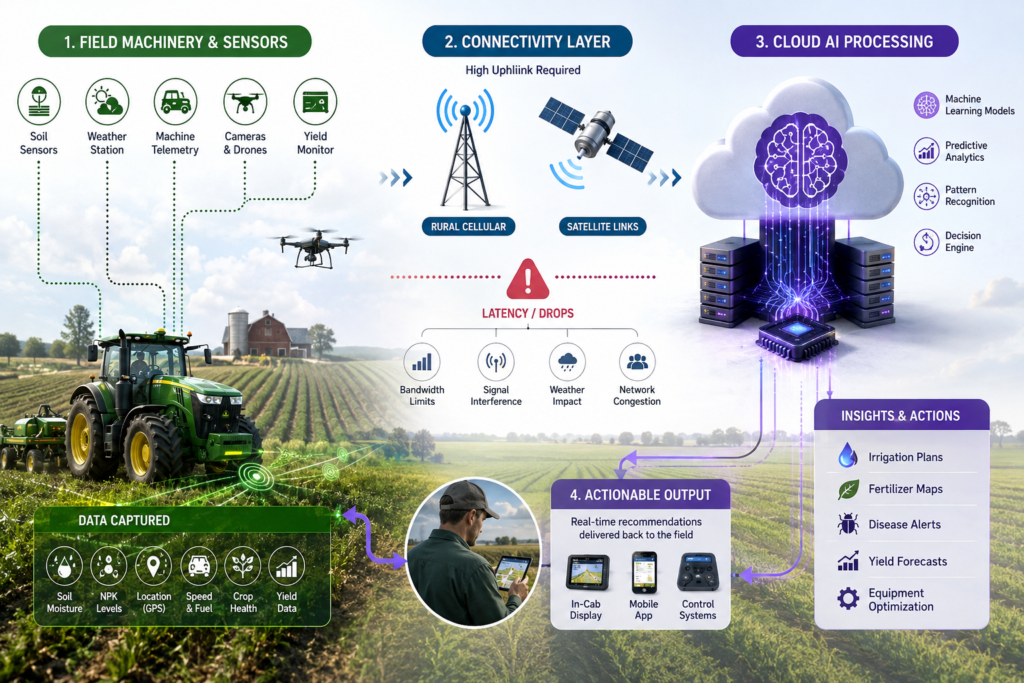
Current federal broadband benchmarks often fail to account for the heavy upload requirements of modern agriculture. A fleet of autonomous combines continuously generating high-resolution yield maps and engine telemetry requires symmetrical upload speeds to function properly. When field infrastructure relies on high-latency satellite connections or congested 4G cellular links, real-time data processing drops, leaving equipment unable to execute adaptive software prescriptions on the fly.
Data Complexity and Technical Onboarding
The deployment of smart farming tools creates a massive influx of raw data that can easily overwhelm operators. A typical connected farm generates gigabytes of soil profiles, multi-spectral images, and yield maps every week.
Without specialized agronomic training or dedicated technical support, converting these data sheets into actionable field decisions is incredibly difficult. This steep learning curve forces many operators to rely on expensive third-party data specialists to translate their software insights into actual field adjustments.
Where Machine Learning in Agriculture Is Heading Next
The agricultural technology sector is rapidly transitioning beyond basic predictive models toward completely integrated, closed-loop automation hubs. The focus of global agricultural engineering is moving away from standalone apps toward large-scale foundation models built specifically for agricultural variables.
The next generation of smart farming systems will likely be shaped by several upcoming innovations:
- Fully Autonomous Field Ecosystems: Fleets of small, coordinated robotic units working together to plant, scout, and spot-treat fields without a single operator sitting in a cab.
- Generative Agronomic Foundation Models: Large-scale AI architectures trained on decades of worldwide soil, climate, and crop genetics data to provide predictive yield forecasts.
- Real-Time Edge-Computed Chemical Targeting: Next-generation weed-identification systems capable of identifying and treating multiple weed species at high field speeds.
- Deep Space-Integrated Analytics: Direct integration with low-Earth-orbit satellite constellations to deliver high-resolution crop health updates every day, bypassing local connectivity issues.
As these systems mature, the overall business of running a farm will become increasingly software-defined. Future agricultural profitability will belong to operators who can most efficiently collect, process, and execute on hyper-local field data.
Frequently Asked Questions (FAQs)
How does machine learning optimize farming?
Machine learning optimizes farming operations by analyzing massive agronomic data streams to automate field tasks. It uses data from sensors, satellites, and equipment to calculate the exact amount of water, fertilizer, and pesticide needed for every square meter of a field, maximizing yields while minimizing chemical waste.
What is machine learning in agriculture?
Machine learning in agriculture refers to the use of advanced computer algorithms to spot hidden patterns in farming data. These systems process complex variables like weather history, soil hydration, leaf color, and machine telemetry to help farmers make fast, data-backed operational choices.
What machinery uses machine learning in farming?
Modern agricultural hardware utilizing machine learning includes autonomous tractors, smart variable-rate sprayers, agricultural scouting drones, automated milking systems, and GPS-guided planters. These machines use edge computing to process environmental data directly in the field.
Does machine learning increase crop yields?
Yes, machine learning systems routinely boost yields by catching crop diseases early, optimizing planting schedules, and ensuring plants receive the ideal mix of nutrients and water. However, final yield improvements depend heavily on the accuracy of the local data collected and how well the equipment is integrated into the field.
What is precision agriculture?
Precision agriculture is a data-driven farming strategy that uses specialized sensors, GPS tracking, and machine learning to manage fields at a hyper-local level. Instead of treating a whole 500-acre field the exact same way, precision systems allow farmers to apply tailored amounts of inputs to specific crop rows.
Is machine learning only useful for large farms?
No. While large commercial operations adopt these technologies faster due to bigger capital budgets, smaller farms can find great value in accessible entry-level tools. Mobile crop-scouting apps, low-cost soil sensors, and local drone imaging services allow smaller operators to leverage machine learning analytics without buying a brand-new autonomous tractor.
What are the biggest challenges in agricultural machine learning?
The primary adoption barriers include high upfront hardware installation costs, poor high-speed internet options in remote rural areas, and the difficulty of interpreting complex data sets without specialized technical support.
Can machine learning reduce water and fertilizer waste?
Yes. By using real-time soil moisture sensors and variable-rate application maps, machine learning systems ensure that water and nitrogen are applied only where the soil is actually deficient, preventing chemical runoff and lowering overall utility costs.