
In the modern digital landscape, software is the invisible architecture that governs nearly every aspect of our lives. At its simplest, software is a set of instructions, data, or programs used to operate computers and execute specific tasks. It is the intelligence behind the hardware, transforming raw electronic components into functional tools like smartphones, medical imaging systems, and global financial networks.
The scale of this industry is staggering. Recent market studies indicate that the global software market is currently valued at over $710 billion in 2026, with a projected compound annual growth rate that shows no signs of slowing. Research suggests that organizations are now spending more on custom software development than ever before, as businesses shift from buying off-the-shelf solutions to building proprietary ecosystems to gain a competitive edge. To truly appreciate this massive shift, one must look past the code and understand the actual craft behind it.
What Is Software Development?
Software development is the structured process of conceiving, specifying, designing, programming, documenting, testing, and bug fixing involved in creating and maintaining applications, frameworks, or other software components. It is a collaborative discipline that blends technical engineering with creative problem-solving.
Rather than being a singular act of writing code, professional software development is a holistic lifecycle. It begins with identifying a specific human or business need and ends with a functional digital product. Developers use various programming languages and methodologies to ensure that the final product is not only functional but also scalable, secure, and user-friendly. In essence, it is the bridge between a conceptual idea and a tangible digital reality.
Why Software Development Is Critical Today
We no longer live in a world where software is just a feature of a business; today, the software is the business. From the way we order food to the way satellites orbit the Earth, software development has become the primary engine of global innovation.
There are several factors making this field business-critical in the current climate:
- Digital Transformation: Companies that fail to modernize their legacy systems with custom software are quickly overtaken by more agile, cloud-native competitors.
- Data-Driven Decision Making: Modern software allows organizations to capture and analyze massive amounts of data in real-time, turning raw information into actionable strategy.
- Automation and Efficiency: By developing custom tools to handle repetitive tasks, businesses can drastically reduce human error and operational costs.
The Types of Software Development
Because software serves so many different purposes, the field is divided into several specialized branches. Each type requires a unique set of tools, languages, and architectural patterns.
Web Development
This is the process of creating applications that run in a web browser. It is typically split into Frontend, which is what the user sees, and Backend, the server-side logic and database. With the rise of the cloud-first mentality, web development has evolved from simple websites into complex web-based applications like Google Docs or Netflix.
Mobile App Development
This specialty focuses on creating software for smartphones and tablets. Developers must choose between Native development, built specifically for iOS or Android, or Cross-Platform development, using a single codebase for both. Given that the majority of global internet traffic now comes from mobile devices, this is one of the most high-demand areas in the industry.
Desktop Application Development
While web apps are popular, high-performance software, such as video editing suites, heavy-duty engineering tools, and gaming environments, still relies on Desktop Development. These applications are built to run locally on operating systems like Windows, macOS, or Linux, allowing them to leverage the full power of a computer’s hardware.
Enterprise Software Development
Enterprise software is designed to solve the problems of an entire organization rather than an individual user. This includes ERP (Enterprise Resource Planning) and CRM (Customer Relationship Management) systems. These applications are characterized by their massive scale, complex security requirements, and the need to integrate with dozens of other internal tools.
Embedded Systems Development
This is the hidden side of software development. Embedded developers write code for non-computer devices, such as the software that controls a car’s braking system, a microwave’s timer, or a heart monitor in a hospital. This requires a deep understanding of hardware constraints, as the software must be incredibly efficient and reliable.
How Software Development Actually Works (Step-by-Step)
The journey from a whiteboard concept to a functional application is rarely a straight line. It is a highly collaborative and iterative process that requires a delicate balance between technical precision and business logic. To a professional developer, the code itself is simply the final expression of a long series of strategic decisions.
Step 1: Idea or Problem Identification
Every piece of software starts with a specific why. This could be a global corporation wanting to automate its payroll or a startup identifying a gap in the social media market.
In this initial stage, the primary goal is validation. Stakeholders and product managers ask critical questions: Is the software technically feasible? Does the potential return on investment justify the development costs? Without a solid yes to these questions, a project may be scrapped before it ever reaches a developer’s desk.
Step 2: Requirements Gathering
Once a project is greenlit, the team moves into discovery. Business analysts and lead developers work together to document exactly what the software must do. These are typically divided into two categories:
- Functional Requirements: These define the specific features, such as the user must be able to reset their password via email.
- Non-Functional Requirements: These define the system’s behavior, such as the application must load in under two seconds or the system must support 10,000 concurrent users.
This phase acts as the foundation. If the requirements are vague, the final product will almost certainly miss the mark.
Step 3: System Architecture and Design
Before a single line of code is written, the blueprints must be drawn. Software architects decide which technologies will be used, how the data will be stored, and how different parts of the system will communicate.
A well-designed architecture ensures the software is scalable and maintainable. For instance, an architect might choose a microservices approach for a large-scale app to ensure that if one feature fails, the entire system doesn’t go offline.
Step 4: Development (The Coding Phase)
This is the construction phase where the designs are translated into a programming language like Python, Java, or JavaScript.
In modern professional environments, this work is done in small, manageable chunks called sprints. This allows for constant peer review and testing, ensuring that errors are caught early in the process rather than at the very end. It is a high-focus period where logical problem-solving meets syntax.
Step 5: Testing and Quality Assurance (QA)
Writing code is only half the battle; the other half is making sure it actually works under pressure. QA engineers put the software through its paces, looking for bugs, security vulnerabilities, and usability issues.
Professional testing involves several layers:
- Unit Testing: Testing individual functions of the code.
- Integration Testing: Ensuring different modules work together.
- User Acceptance Testing (UAT): Having real users try the software to ensure it meets their actual needs.
Step 6: Deployment to Production
Once the software is deemed stable and secure, it is shipped to the production environment. This might mean uploading a mobile app to the Apple App Store or deploying a web application to a cloud provider like AWS or Azure.
Modern teams often use automated deployment pipelines, which allow them to push updates to users instantly without taking the entire service offline. This ensures that the transition from a development version to a live version is as seamless as possible for the end-user.
Step 7: Monitoring and Maintenance
The work does not end at launch. Software is a living entity that requires constant care. Professional teams use monitoring tools to track performance in the real world, looking for crashes, slow load times, or unexpected user behavior.
This data is used to release patches, fix remaining bugs, and plan new features for the next version of the software. Maintenance can often last for years, long after the initial development phase is finished.
The Software Development Lifecycle (SDLC)
While the steps above describe the what, the Software Development Lifecycle (SDLC) provides the how. It is a formal methodology that organizations use to ensure high-quality software is produced in the shortest possible time.
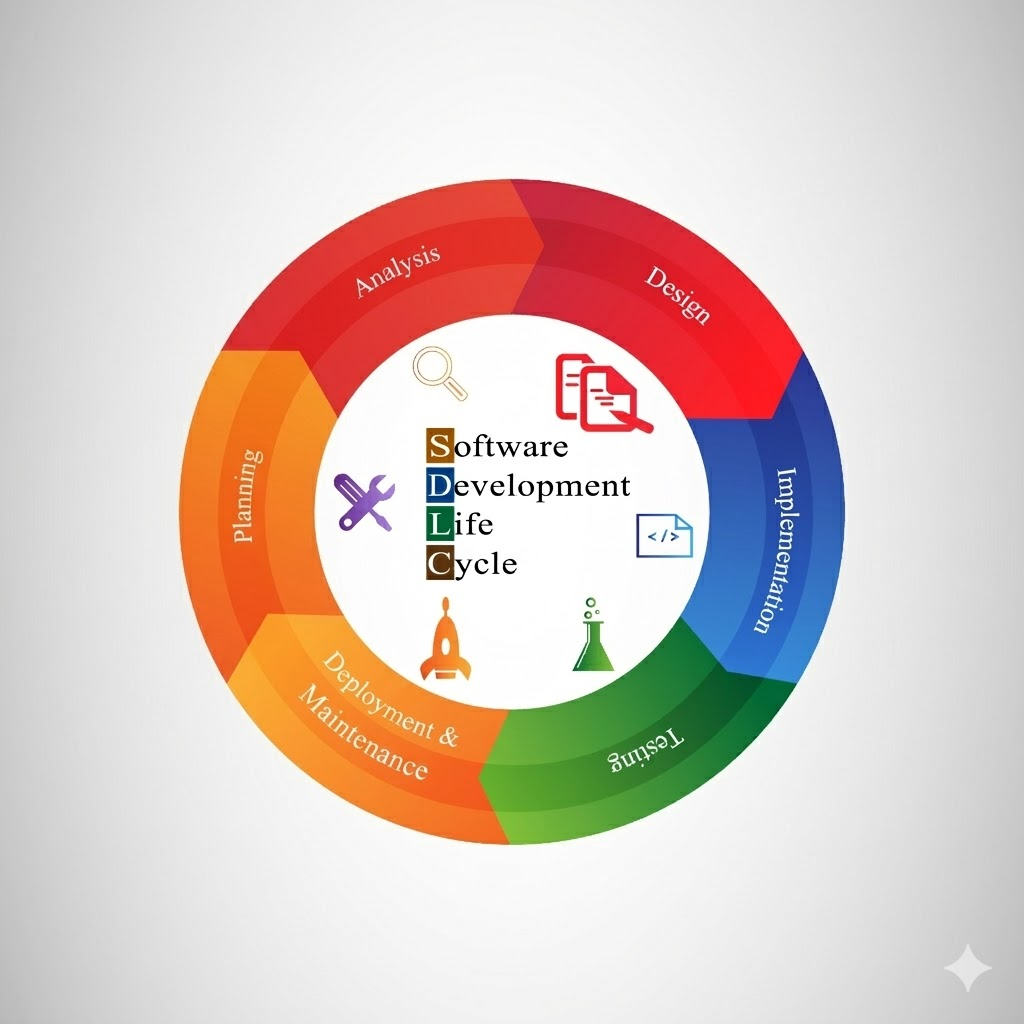
The SDLC ensures that a project moves through a predictable, disciplined cycle. Each phase has its own set of deliverables:
- Planning: Defining scope and assessing risks.
- Analysis: Deep-diving into user needs.
- Design: Creating technical specifications.
- Implementation: The actual coding and building.
- Testing: Verifying the product against the requirements.
- Deployment & Maintenance: Releasing and sustaining the software.
By following a defined SDLC, companies can avoid the chaos of unorganized coding, leading to fewer bugs, lower costs, and a more successful final product.
Software Development Methodologies
A methodology is the philosophy a team follows to manage their work. Choosing the right one can be the difference between a project that ships on time and one that collapses under its own weight.
Agile Development
Agile is the most widely used approach in modern software engineering. It is based on the idea of iterative development, where requirements and solutions evolve through the collaborative effort of self-organizing, cross-functional teams.
Instead of trying to build the entire product at once, Agile breaks the project into small, consumable increments. This allows the team to pivot quickly if the market changes or if the initial requirements turn out to be incorrect. It prioritizes customer feedback and functional software over exhaustive documentation.
Waterfall Model
The Waterfall model is the traditional, linear approach to software development. In this model, each phase must be completed before the next one begins. It follows a strict sequence: Requirements, Analysis, Design, Coding, Testing, and Operations.
While Waterfall is often criticized for being inflexible in a fast-paced digital world, it remains highly effective for projects with fixed requirements and strict regulatory oversight. This includes high-stakes environments like aerospace software or large-scale government infrastructure. In these sectors, a change mid-way through the process could be catastrophic for both the budget and public safety.
DevOps Approach
DevOps is more of a cultural shift than a simple step-by-step method. It focuses on breaking down the silos between the development teams (who write the code) and the operations teams (who manage the servers).
By using automation and Continuous Integration/Continuous Deployment (CI/CD) pipelines, DevOps allows companies to release updates dozens or even hundreds of times a day. The goal is to shorten the development life cycle and provide high software quality with continuous delivery.
Scrum Framework
Scrum is a specific way to implement Agile. It organizes work into fixed-length periods called Sprints, typically lasting two to four weeks.
Scrum relies on specific roles, such as the Scrum Master (who removes obstacles) and the Product Owner (who defines the vision). Daily Stand-up meetings ensure everyone is aligned, and a Sprint Review at the end of each cycle allows the team to demonstrate what they have built and gather immediate feedback.
Core Components of Software Development
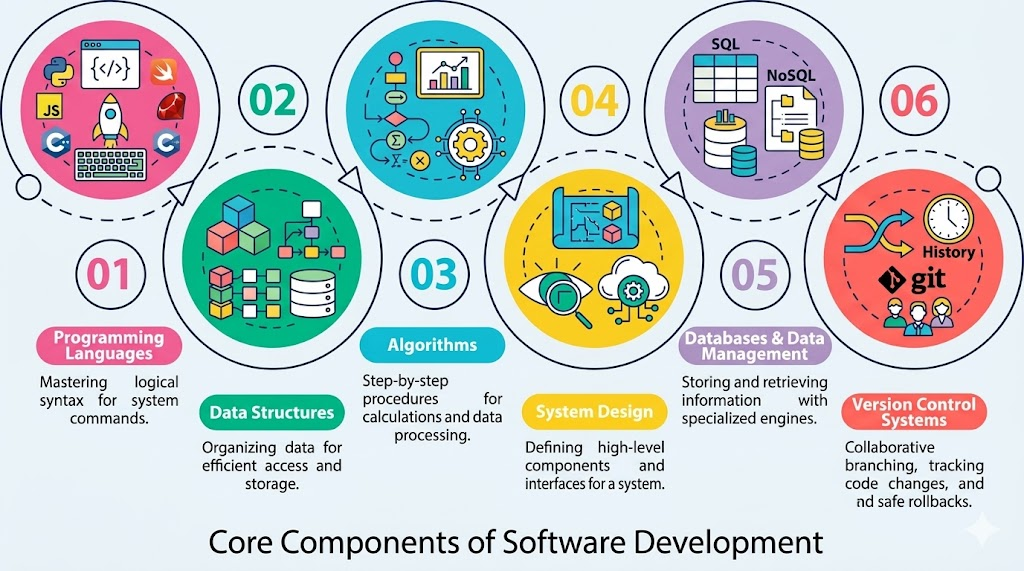
Behind every application lies a complex set of technical building blocks. A professional developer must master these core components to build systems that are not just working, but are also efficient and scalable.
Programming Languages
Languages are the tools used to communicate instructions to a computer. They range from High-Level Languages like Python or Ruby, which are easy for humans to read, to Low-Level Languages like C or Assembly, which provide direct control over a computer’s hardware.
The choice of language usually depends on the project’s goal. For instance, JavaScript is the standard for web interactivity, while Swift or Kotlin are the go-to choices for mobile apps.
Data Structures and Algorithms
If programming languages are the words, then Data Structures and Algorithms are the grammar and logic.
- Data Structures (like Arrays, Linked Lists, or Hash Tables) are specialized ways of organizing and storing data so that it can be accessed and worked with efficiently.
- Algorithms are the step-by-step procedures for calculations or data processing.
A developer who understands these principles can write code that runs significantly faster and uses far less memory. This is a critical skill for anyone dealing with big data or high-traffic applications.
System Design and Architecture
System design is the high-level process of defining the components, modules, and interfaces of a system. A professional architecture ensures that a system is decoupled, meaning one part can be changed without breaking everything else.
Common patterns include Monolithic architecture (where everything is in one piece) and Microservices (where the app is broken into small, independent services).
Databases and Data Management
Most software needs a place to remember things. Databases are the engines that store and retrieve this information.
- Relational Databases (SQL): Like MySQL or PostgreSQL, these use tables and are perfect for structured data with clear relationships.
- Non-Relational Databases (NoSQL): Like MongoDB, these are more flexible and are often used for massive amounts of unstructured data or real-time web apps.
Version Control Systems
In a professional setting, multiple people are often working on the same files at the same time. Version Control Systems (VCS), like Git, act as a time machine for code. They track every change made to the source code, allowing developers to collaborate without overwriting each other’s work. If a new update causes a bug, Git allows the team to roll back to a previous, stable version in seconds.
Tools Used in Software Development
A developer’s productivity is often defined by the quality of their toolkit. Modern software development has moved far beyond simple text files; it now relies on a sophisticated ecosystem of integrated tools designed to automate the mundane and catch errors before they reach the user.
Code Editors and IDEs
The Integrated Development Environment (IDE) is the primary workspace for any developer. Unlike a basic text editor, an IDE like Visual Studio Code, IntelliJ IDEA, or PyCharm provides a suite of built-in features. These include syntax highlighting (which color-codes the text to make it readable), auto-completion, and integrated debugging tools. These environments act as a digital cockpit, allowing a programmer to write, test, and run their code all from a single window.
Version Control Tools (i.e., Git)
In a professional setting, software is rarely built by a single person. Version Control Systems (VCS), specifically Git, are essential for collaboration. Git acts as a high-fidelity time machine for code. It allows multiple developers to work on the same project simultaneously by creating branches. Once a feature is finished, it can be merged back into the main project. If an error is introduced, the team can roll back the entire codebase to a previous, stable version in seconds.
CI/CD Tools
Continuous Integration (CI) and Continuous Deployment (CD) tools, such as Jenkins, GitHub Actions, or GitLab CI, are the engines of the DevOps movement.
These tools automatically build and test the code every time a developer saves a change. This ensures that new code does not break existing features. By automating the path from a developer’s laptop to the live server, CI/CD reduces the risk of human error during the release process.
Cloud Platforms
The days of buying physical servers are largely over. Today, software is built and hosted on Cloud Platforms like Amazon Web Services (AWS), Microsoft Azure, or Google Cloud. These platforms provide on-demand computing power, storage, and databases. This allows a small startup to scale their application to millions of users instantly without ever touching a piece of hardware.
Testing Tools
Quality is not an accident; it is a product of rigorous testing. Professional teams use specialized tools like Selenium for web automation, Jest for JavaScript testing, or Postman for testing how different software services talk to each other (APIs). These tools allow developers to write tests for their code, which can be run thousands of times to ensure every edge case is covered.
Common Challenges in Software Development
Despite the advanced tools available, software development remains a difficult craft. Professional teams frequently navigate several high-stakes challenges:
- Scope Creep: This occurs when a project’s requirements grow uncontrollably during the development process, often leading to missed deadlines and blown budgets.
- Technical Debt: This refers to the cost of choosing an easy, quick-fix solution now instead of using a better approach that would take longer. Over time, technical debt makes a system harder and more expensive to maintain.
- Security Vulnerabilities: As hackers become more sophisticated, ensuring that code is secure from the start is a constant battle. A single oversight in an API or a database query can expose millions of user records.
- Communication Gaps: Software is built by humans for humans. If the developers do not clearly understand what the business stakeholders need, the final product (no matter how technically perfect) will be a failure.
Modern Trends in Software Development
The industry is currently undergoing a massive transformation, driven by artificial intelligence and a shift toward more modular, flexible architectures.
AI-Assisted Development
The rise of AI Pair Programmers, such as GitHub Copilot, is fundamentally changing how code is written. These tools can suggest entire blocks of code, write documentation, and even suggest fixes for bugs. While they do not replace the need for human developers, they act as a massive force multiplier, allowing engineers to focus on high-level logic rather than repetitive syntax.
Low-Code and No-Code Platforms
For simpler business applications, Low-Code platforms are gaining massive traction. These allow non-developers to build functional software using drag-and-drop interfaces. While they aren’t suitable for complex, high-performance systems, they are perfect for internal business tools, allowing professional developers to focus on more challenging problems.
Microservices Architecture
Modern applications are increasingly moving away from Monolithic designs. In a Microservices architecture, a single application is broken down into dozens of small, independent services that communicate with each other. This means a team can update the Payment service without ever touching the User Profile service, making the entire system much more resilient and easier to scale.
Cloud-Native Development
This is the practice of building software specifically to live in the cloud. Cloud-native applications are designed to be elastic, meaning they can automatically grow or shrink their resource usage based on how many people are using them. This reduces costs and ensures that the application is always available, even if one part of the cloud infrastructure fails.
Containerization (i.e., Docker)
Containerization involves wrapping a piece of software and all its requirements (libraries, settings, etc.) into a single container.
Tools like Docker ensure that the software runs exactly the same way on a developer’s laptop as it does on a massive production server. This solves the classic it works on my machine problem and is a cornerstone of modern, scalable software deployment.
Software Development Best Practices
The difference between a successful project and a maintenance nightmare often lies in the discipline of the development team. Professional standards ensure that software is not just functional today, but remains adaptable and secure for years to come.
Writing Clean and Maintainable Code
Code is read far more often than it is written. Clean code is the practice of writing logic that is easy for another human to understand. This involves using descriptive variable names, keeping functions small and focused on a single task, and avoiding clever tricks that obscure the intent of the program. If a developer has to spend hours deciphering a single file, the code is technically debt rather than an asset.
Code Reviews and Collaboration
In a professional environment, no code goes to production without a second pair of eyes. Code reviews are a collaborative process where peers examine each other’s work to catch bugs, suggest optimizations, and ensure consistent style. This culture of shared ownership prevents a single point of failure and acts as a continuous learning mechanism for the entire team.
Automated Testing
Relying on human manual testing is slow and prone to error. High-quality development relies on Automated Testing suites that run every time a change is made.
- Unit Tests verify the smallest parts of the application.
- Integration Tests ensure different systems talk to each other correctly.
- End-to-End Tests simulate a real user’s journey. This safety net allows developers to move fast without the fear of breaking existing features.
Continuous Integration and Deployment (CI/CD)
Modern teams use CI/CD pipelines to automate the path from a developer’s computer to the live server. By integrating code frequently and automating the deployment process, organizations can release updates with high confidence. This reduces the big bang release risk where months of work are pushed at once, replaced instead by small, low-risk daily updates.
Security-First Development
Security is no longer something you add at the end. Security-First development involves integrating safety checks into every stage of the lifecycle. This includes scanning for known vulnerabilities in third-party libraries, using secure coding patterns to prevent SQL injection, and ensuring that sensitive data is always encrypted.
Software Development vs. Software Engineering
While these terms are often used interchangeably, there is a subtle but important distinction in a professional context.
Software Development is the broader act of creating software. It is a creative and functional process focused on building a product that works.
Software Engineering, however, is the application of formal engineering principles to the development of software. It focuses more heavily on the systematic, disciplined, and quantifiable approach to the operation and maintenance of software. If development is about building the house, engineering is about ensuring the structural integrity, the plumbing, and the electrical systems are designed to withstand a century of use.
Can Software Ever Be Perfect?
In the world of professional engineering, the answer is a firm no. Software is a reflection of human logic, and because humans are fallible, software will always contain edge cases or hidden bugs.
Furthermore, software exists in a constantly changing environment. Operating systems update, hardware evolves, and user needs shift. A program that is perfect today might be broken by a browser update tomorrow. The goal of a professional team is not perfection, but reliability and maintainability (the ability to fix issues quickly and adapt to change without the system collapsing).
Who Is Involved in Software Development?
Building an enterprise application requires more than just programmers. It is a team sport involving several specialized roles:
- Product Managers: Define the what and why of the product.
- UX/UI Designers: Focus on how the software looks and feels to the user.
- Backend/Frontend Developers: Build the logic and the interface.
- QA Engineers: Ensure the software is free of critical bugs.
- DevOps Engineers: Manage the servers and deployment pipelines.
While these roles have distinct responsibilities, the most successful projects are characterized by a blurring of the lines. In a professional environment, developers often contribute to design discussions, and designers must understand technical constraints.
This cross-functional collaboration is what prevents the silos that often lead to project delays or a product that fails to meet market needs.
How to Get Started in Software Development
The barrier to entry in this field has never been lower, but the path to professional mastery remains long and demanding. For those looking to enter the field, the journey typically follows a specific progression:
- Select a Foundational Language: Start with Python for its readability or JavaScript if you are interested in building for the web.
- Building Projects: Theory is a vital starting point, but you only truly learn when you are forced to solve a bug in a program you built yourself.
- Understanding Version Control: Learn Git immediately. In the professional world, code that isn’t in a version control system effectively does not exist.
- Contributing to Open Source: Contribute to open-source projects on GitHub or participate in technical forums. This exposes you to how senior engineers write and review code.
Ultimately, getting started is less about memorizing syntax and more about developing a logical mindset. Technology moves at a breakneck pace; the framework you learn today may be obsolete in three years. Therefore, the most valuable skill a new developer can cultivate is the ability to learn how to learn.
Professional software development is a career of lifelong education. If you possess a deep curiosity for how things work and a stubborn persistence in the face of complex problems, you will find this field to be one of the most rewarding and impact-driven professions in the modern economy.
FAQs
What is software development in simple terms?
It is the process of creating computer programs. This includes everything from the initial idea and design to writing the code, testing it, and making sure it keeps working after it is released.
What are the main stages of software development?
The core stages are Planning, Analysis, Design, Implementation (Coding), Testing, Deployment, and Maintenance.
Which programming languages are best for beginners?
Python is widely recommended for its simple syntax. JavaScript is also a great choice because it allows you to see immediate results in a web browser.
What is the difference between software development and programming?
Programming is the specific act of writing code. Software development is the entire process of building a product, which includes research, design, testing, and management.
How long does it take to develop software?
A simple mobile app might take 3 to 6 months, while a complex enterprise system can take years of continuous development.
What tools do software developers use?
They use IDEs (like VS Code), Version Control (like Git), Cloud Platforms (like AWS), and Testing Frameworks to ensure their code is correct and scalable.
What is Agile in software development?
Agile is a methodology that focuses on building software in small, iterative steps rather than all at once. It prioritizes flexibility and constant feedback from the user.
Is software development a good career?
Yes. It offers high salaries, the ability to work remotely, and the opportunity to solve complex, real-world problems in almost every industry.
What are the biggest challenges in software development?
Common hurdles include Scope Creep (requirements changing constantly), Technical Debt, and maintaining Security in a world of evolving threats.
How is AI changing software development?
AI is acting as a coding assistant. It helps developers write code faster and find bugs more easily, but it still requires human oversight to ensure the logic and security are correct.