E-commerce has fundamentally changed over the last decade. Online stores no longer compete only on pricing or product quality. Modern growth now depends heavily on how effectively a business manages customer relationships after the first interaction.
This shift is exactly why email marketing automation became one of the most important operational systems inside digital commerce.
Manual email campaigns cannot scale effectively in modern online retail environments. Customers now expect personalized recommendations, timely reminders, post-purchase engagement, and consistent communication across every stage of the buying journey. Businesses that fail to automate these interactions often lose revenue to competitors that operate with faster and smarter lifecycle marketing systems.
At the center of this transformation is automated email marketing.
Instead of sending generic mass emails, modern e-commerce companies now use behavioral triggers, AI-powered segmentation, predictive customer journeys, and automated retention workflows to drive repeat purchases and increase customer lifetime value.
This guide explains what email marketing automation actually is, how modern automation systems work, how AI is changing email workflows, and why automated customer communication became essential for e-commerce growth in the United States digital economy.
What Is Email Marketing Automation?
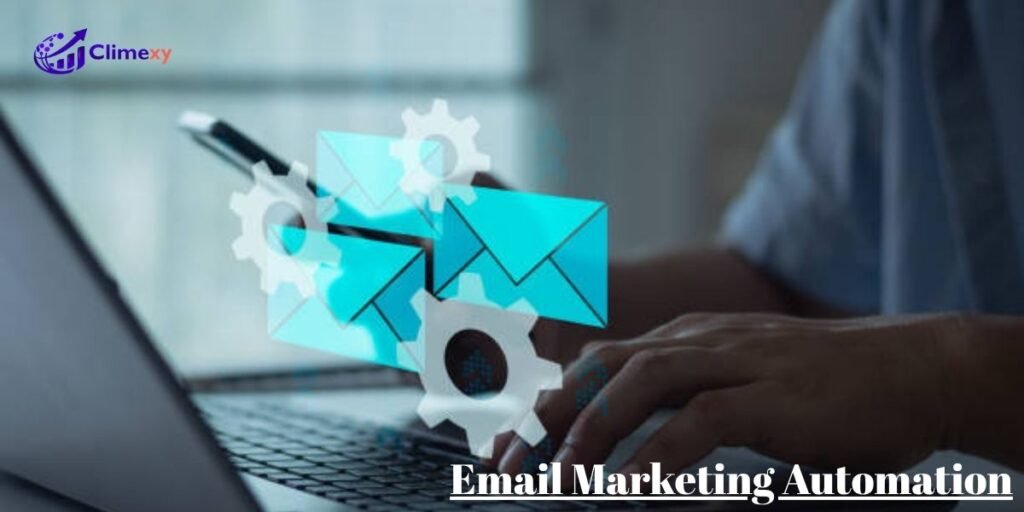
Email marketing automation is the process of using software systems to automatically send personalized emails based on customer behavior, timing conditions, purchase activity, engagement signals, or predefined workflow logic.
Instead of manually creating and sending every campaign, businesses build automated systems that trigger communication when specific events occur.
Modern infrastructure allows systems to track explicit user actions on a store and cross-reference them with historical data profiles. This ensures that the message delivered aligns precisely with the user’s immediate intent.
The key difference between traditional email campaigns and automated email marketing is that automation reacts dynamically to user behavior rather than relying entirely on manual scheduling. Traditional marketing requires a marketer to sit down, draft a message, select a list, and hit send at a specific hour.
Automation removes this human bottleneck completely. Modern automation platforms operate continuously in the background, creating a persistent customer communication engine that functions even when the business owner is offline.
The underlying technology relies on deep integrations with the e-commerce database, pulling product metadata, inventory counts, and customer transaction records in real time. The resulting workflows ensure no communication opportunities are missed.
The system scales effortlessly whether you are dealing with 100 subscribers or 1000000 concurrent users. To fully understand the scope of these automated systems, it helps to examine the foundational messages that build the core infrastructure of an e-commerce brand.
The most common execution models include the following types of automated communications:
- Welcome Sequences: Sent immediately after a user submits an email address via a popup or footer form.
- Abandoned Cart Reminders: Triggered when an authenticated user leaves items in their shopping cart without completing checkout.
- Post-Purchase Follow-ups: Dispatched after a completed transaction to provide shipping details, care instructions, or cross-sell options.
- Reactivation Workflows: Targeted at previously active buyers who have not completed a purchase within a specific window, such as 90 days.
- Replenishment Notifications: Timed to arrive just before a consumable product is expected to run out based on average consumption rates.
- Personalized Product Recommendations: Driven by browsing history data to surface relevant merchandise to active shoppers.
Why Email Marketing Automation Became Essential for E-Commerce
The rise of e-commerce created an enormous operational problem for online businesses. Traffic acquisition became increasingly expensive, altering the baseline unit economics of digital retail.
Paid advertising costs rose across major networks including Google Ads, Meta platforms, TikTok advertising, influencer sponsorships, and affiliate acquisition systems. This surge in customer acquisition cost meant that brands could no longer rely on a single transaction to achieve profitability.
A business paying high acquisition fees just to win a first sale will lose money if that buyer never returns. Because acquiring new customers became more expensive, businesses shifted focus toward maximizing the value of existing customers.
This is where automation became essential. It provides a programmatic framework to turn one-time shoppers into repeat buyers without scaling human overhead.
By deploying targeted retention mechanisms, automated email systems help businesses achieve major efficiency milestones:
- They recover abandoned carts before the shopper turns to a competitor.
- They systematically increase repeat purchase rates via automated cross-selling.
- They improve customer retention metrics by maintaining consistent touchpoints.
- They reduce customer churn through automated early-intervention messaging.
- They extend customer lifetime value by keeping the brand top-of-mind over multi-month windows.
- They improve net profit margins because email re-engagement carries no incremental ad spend.
In modern e-commerce, retention is often more profitable than acquisition. Data from global retail studies consistently demonstrates that returning customers buy more frequently and spend more per transaction than first-time visitors.
A properly configured automation system can generate revenue continuously without requiring constant manual campaign management. This structural leverage allows small teams to compete directly with enterprise conglomerates.
This is why SaaS-based email marketing automation tools became core infrastructure for Shopify stores, DTC brands, subscription businesses, and modern online retailers. Without an automated retention stack, an online store operates at a structural disadvantage every time it bids for traffic on paid ad exchanges.
How Automated Email Marketing Works
Automated email marketing systems function through workflow logic. Think of an automation workflow as a visual flowchart that routes users down specific communication paths based on what they do or who they are.
Every workflow operates using four primary components that govern its execution from start to finish.
1. Triggers
A trigger is the exact event that starts an automation sequence. It serves as the entry gate for the customer journey.
The trigger tells the platform when the workflow should begin. The system monitors the store data feed 24 hours a day for these specific signals.
Common technical triggers include:
- A customer signs up for a newsletter or promotional discount list.
- A product is added to a shopping cart but checkout is not initiated.
- A purchase is successfully completed through the payment gateway.
- A customer profile shows no interaction or login activity for 60 days.
- A specific product page is viewed multiple times by the same authenticated visitor.
- An active subscription is canceled by the user.
2. Conditions
Conditions determine whether a customer qualifies for specific workflow paths once they are inside the automation. They act as data-driven filters that sort your audience in real time.
Conditions create personalized customer experiences instead of sending identical emails to everyone. This prevents a store from sending a first-time buyer discount code to a loyal customer who has already placed ten orders.
Common validation conditions include:
- Checking if the total order value exceeds a premium threshold like $100.
- Verifying if the customer is physically located within the United States.
- Matching whether the user is a first-time buyer or a returning patron.
- Evaluating if the customer belongs to a designated VIP customer segment.
- Filtering by the specific product category or brand SKU purchased.
3. Actions
Actions define what happens inside the workflow after triggers are fired and conditions are checked. They are the actual executions performed by the marketing software.
These actions create automated customer journeys that adapt to real-time events. They allow the system to handle data management tasks alongside content delivery.
Standard automated actions include:
- Dispatching a specific email design to the user’s inbox.
- Halting the workflow with a structured wait state before moving to the next block.
- Adding a tracking tag like High-Value Buyer to the customer profile.
- Updating custom data fields within the connected CRM platform.
- Triggering a complementary SMS message to mobile subscribers.
- Pushing an internal notification to the customer service or sales team.
- Dynamically rendering personalized product blocks within an email template.
4. Timing Logic
Timing determines when each step occurs within your automated sequences. Poor timing destroys email performance and frustrates recipients.
Sending an abandoned cart reminder five minutes after someone leaves your store can look overly aggressive, while waiting five days means the buyer has likely found a solution elsewhere.
Modern systems optimize timing based on cross-platform performance metrics. They manage the delay between actions to ensure communication matches natural human behavior.
Key timing elements include:
- Determining the optimal send time of day based on historic open patterns.
- Capping the frequency of emails to avoid over-saturating an inbox.
- Implementing strategic engagement pacing for long-term educational sequences.
- Aligning delivery with regional timing based on customer time zones.
- Executing behavioral timing that adjusts based on real-time activity metrics.
AI-driven systems now dynamically predict optimal delivery windows based on individual user behavior patterns, moving beyond static rules to self-optimizing schedules.
Core Automated Email Workflows Used in E-Commerce
To build a resilient retention engine, an online retailer must implement specific core workflows. These sequences target distinct phases of the consumer lifecycle, turning anonymous traffic into advocates.
Welcome Email Series
The welcome sequence is usually the highest-performing automation in most online stores. New subscribers are most engaged immediately after signup, making this your prime window to capture attention and secure an initial order.
The objective is converting a subscriber into a customer quickly while their interest is at its peak. This sequence sets the tone for the entire brand relationship.
A typical welcome workflow includes:
- A warm brand introduction that shares the founding story.
- A clear elaboration of the value proposition and product differentiators.
- Focused product education explaining how to use or choose items.
- Compelling social proof including user reviews and media mentions.
- A clear first purchase incentive such as a discount code or free shipping tier.
Abandoned Cart Recovery
Cart abandonment is one of the largest revenue leaks in e-commerce, with industry benchmarks showing that roughly 70% of shoppers leave items behind. Many customers leave because they want to compare prices, become distracted by notifications, or hesitate before committing capital.
Automation recovers lost revenue by sending targeted reminder emails after abandonment occurs. These workflows operate on tight schedules, typically sending the first message within one hour of abandonment to catch the buyer while intent remains high.
High-performing cart workflows often include:
- Clear visual reminders showing the exact abandoned products left in the cart.
- Direct links that rebuild the user’s checkout session instantly with a single click.
- Curated customer reviews addressing common purchasing objections.
- Tiered discount incentives or free gifts for users who hesitate over cost.
- Strategic inventory scarcity messaging indicating low stock levels.
Some brands recover millions in lost capital annually from abandoned cart automations alone, making this workflow a massive priority for revenue optimization.
Browse Abandonment Emails
These workflows trigger when users view specific product pages without adding items to the cart. This strategy captures high-intent visitors before they disappear entirely from your marketing funnel.
Because browse abandonment targets users earlier in the consideration phase, the messaging must be gentler than a cart reminder. It serves as a helpful follow-up rather than a direct sales push.
AI recommendation systems often personalize these emails using:
- The exact browsing behavior and duration recorded during the session.
- Historic product affinity scores calculated from past visits.
- Measured price sensitivity based on the average cost of viewed items.
- Explicit category interest to surface alternative colors, styles, or models.
Post-Purchase Email Automation
The sale is not the end of the customer journey. Modern e-commerce businesses use post-purchase automation to maximize satisfaction during the critical window between payment confirmation and product delivery. This phase dictates whether a customer buys from your store again or requests a refund out of frustration.
Post-purchase systems significantly affect long-term customer retention by transforming a transactional event into a relational experience. By maintaining proactive communication, brands can address shipping anxiety and eliminate customer service bottlenecks before they escalate.
When properly engineered, a post-purchase automation workflow achieves multiple operational goals:
- It drastically reduces customer support tickets and refund requests by providing tracking updates.
- It improves customer satisfaction metrics by delivering immediate usage instructions.
- It systematically encourages user-generated reviews and social media mentions at the moment of peak excitement.
- It increases repeat order rates by suggesting matching accessories or complementary items.
- It introduces loyalty rewards or referral incentives to turn single buyers into brand advocates.
Win-Back Campaigns
Inactive customers represent lost revenue opportunities that have already been paid for through historical acquisition costs. Win-back automation identifies disengaged users who have not interacted with your brand or made a purchase within a specific timeframe, such as 60 days or 120 days.
Re-engaging these users programmatically is often significantly cheaper than acquiring entirely new customers through volatile paid advertising channels. It allows you to sweat your existing asset base rather than continuously paying for new traffic.
A structured win-back workflow sequentially deploys different hooks to recapture attention:
- Highly targeted promotional offers featuring a deep discount to lower the barrier to re-entry.
- Curated new product announcements that highlight how your catalog has evolved since their last order.
- Personalized merchandise recommendations based on their historical purchasing categories.
- Compelling loyalty incentives that reward them for reactivating their account standings.
Replenishment Reminders
Subscription models and consumable-product businesses heavily rely on replenishment automation to stabilize their recurring revenue streams. This applies directly to brands selling goods that naturally expire, run out, or require routine maintenance cycles.
AI models analyze past consumption intervals across your entire customer database to estimate exactly when an individual buyer is about to run out of stock. The system then triggers a hyper-timed message right before that inflection point arrives.
Common industry verticals that generate predictable baseline revenue using replenishment automation include:
- Health and Wellness: Monthly replenishment alerts for vitamin and supplement routines.
- Skincare and Cosmetics: Scheduled reminders for foundations, moisturizers, and facial serums.
- Pet Industry: Automatic alerts for premium pet food, treats, and flea treatments.
- Beverage Brands: Timed reorder sequences for artisan coffee beans or functional beverage flats.
- Home Goods: Recurring reminders for water filters, air filtration screens, and cleaning concentrates.
AI Email Automation and the Future of E-Commerce
AI email automation is transforming how businesses manage customer communication. Traditional automation followed fixed, rigid logic where human marketers guessed what rules would perform best. Modern machine learning systems adapt dynamically based on continuous streams of live performance data.
This evolution is changing the entire e-commerce marketing landscape, shifting the discipline away from batch-and-blast execution toward predictive customer orchestration. Brands utilizing ai automation for e-commerce are replacing static campaigns with fluid, self-optimizing ecosystems.
How AI Improves Automated Email Marketing
The integration of artificial intelligence into automated workflows removes human error and maximizes extraction value across every digital touchpoint.
Predictive Send Time Optimization
AI systems analyze thousands of individual engagement patterns to predict the exact minute a specific user is most likely to open an email. Instead of sending a newsletter to your entire list at 9:00 AM, the system spreads delivery over a multi-hour window, hitting individual inboxes exactly when those users are active. This significantly improves baseline open rates, click-through rates, and bottom-line conversions.
AI-Powered Product Recommendations
Advanced recommendation engines analyze real-time variables, including individual purchase history, granular browsing behavior, category affinity, and cross-user cart patterns. This allows platforms to inject hyper-personalized product suggestions directly into automated layouts. Major digital retailers now depend heavily on these recommendation algorithms to generate their primary retention revenue.
AI Subject Line Optimization
Machine learning models test thousands of subject line permutations instantly, predicting engagement performance based on historic linguistic trends. These AI models evaluate wording choices, emotional tone, structural urgency, sentence readability, and click probability. This ensures that every automated email leaves the server with a subject line mathematically favored to beat out inbox noise.
Behavioral Segmentation
Traditional segmentation relied on manual, static customer groups that required constant maintenance. Modern AI systems build dynamic behavioral profiles automatically, adjusting segment composition as user actions occur. This allows brands to target high-value customers, discount-sensitive buyers, impulse shoppers, and high-risk churn profiles with far greater precision than manual rules allow.
Best Email Marketing Automation Tools for E-Commerce
The modern market is dominated by SaaS-based automation platforms designed to tie directly into major digital storefront infrastructure. Choosing among the best marketing automation for e-commerce platforms requires aligning your operational complexity with the data architecture of the software.
To simplify the selection process, the leading email marketing automation tools can be grouped by their core capabilities and operational design:
- Klaviyo: Widely recognized as the infrastructure standard for scaling e-commerce brands and Shopify stores. It excels due to its advanced segmentation, deep data integration, powerful automation builder, and built-in predictive analytics.
- Omnisend: A highly efficient platform optimized for multi-channel workflows. It features pre-built e-commerce templates and cross-channel automation engines that combine email and SMS into single operational sequences.
- Mailchimp: Historically popular among small businesses and solo entrepreneurs. It offers a beginner-friendly environment for smaller email lists and lightweight automation needs, though it lacks advanced multi-variable logic for complex scaling operations.
- ActiveCampaign: A robust choice that combines customer relationship management (CRM features), sales pipelines, and email marketing. It is exceptionally strong for businesses operating hybrid e-commerce models or advanced, multi-branch customer journeys.
- HubSpot: An enterprise-focused growth platform that unifies marketing automation, customer service desks, sales pipelines, and deep data logging. It is best suited for larger retail operations and complex B2B e-commerce ecosystems requiring extensive custom infrastructure.
Customer Segmentation: The Core of High-Converting Automation
Segmentation determines whether your automated communication feels personalized or spammy. High-performing e-commerce businesses never treat their audience as a single, uniform mass. They use real-time data inputs to segment users dynamically, protecting inbox deliverability and maximizing relevance.
Poor segmentation leads to immediate negative indicators including unsubscribe spikes, elevated spam complaints, plummeting engagement rates, and severe customer fatigue. Modern automation success depends heavily on segment quality, ensuring that the right message reaches the right buyer at the correct phase of their relationship.
To maintain maximum conversion rates, advanced automated workflows segment audiences using distinct data sets:
- Detailed purchase behavior tracking total order counts, average order values, and specific item choices.
- Explicit geographic regions to align messaging with localized seasons, holidays, and regional shipping zones.
- Historic spending patterns to separate discount-reliant shoppers from full-price VIP buyers.
- The immediate lifecycle stage tracking whether a user is an unconverted subscriber, a fresh buyer, or a lapsed customer.
- Measured engagement frequency checking how often an individual opens, clicks, or browses your digital assets.
How Automation Increases E-Commerce Revenue
Implementing marketing automation for e commerce affects multiple revenue layers simultaneously, compounding operational efficiency over time.
Personalized workflows convert significantly better than generic broadcasts because they align directly with immediate user actions. By keeping your brand top-of-mind through structured lifecycle marketing, retention systems keep customers returning, directly accelerating your repeat purchase velocity.
This systemic retention reduces the constant pressure to fund expensive paid customer acquisition strategies. As your automated sequences systematically extend customer lifetime value, each acquired customer becomes significantly more profitable over their multi-month or multi-year relationship with your storefront.
Furthermore, cloud infrastructure handles this communication volume automatically, allowing a business to scale its messaging touchpoints up to millions of executions without expanding its operational head count or increasing human management hours.
The Role of SaaS in Modern Marketing Automation
Cloud-based software-as-a-service (SaaS) infrastructure democratized advanced email automation. Previously, sophisticated behavioral tracking and predictive modeling systems were available mainly to enterprise corporations with massive capital allocations and dedicated data engineering departments.
Modern subscription platforms changed this dynamic completely. Today, a solo entrepreneur operating a brand-new storefront can deploy the exact same enterprise-grade automation systems, predictive models, and trigger logic used by multi-million dollar global retailers.
This technical democratization has accelerated the adoption of automated digital ecosystems worldwide, making data-driven optimization accessible to anyone with a browser and a storefront integration.
Why Email Automation Still Outperforms Many Social Channels
Social media platforms control consumer access through volatile, proprietary algorithm updates. An e-commerce brand can lose its organic reach overnight due to hidden system changes on platforms like Instagram, TikTok, or Facebook.
Conversely, an email database is an owned asset under direct business control. Email automation creates long-term financial stability inside volatile digital advertising ecosystems.
This structural ownership is the primary reason experienced digital commerce operators prioritize email retention engines over social media metrics. Social channels are excellent for initial discovery, but automated email workflows remain the most reliable mechanism for extracting reliable, consistent lifetime enterprise value.
Final Thoughts
Email marketing automation evolved from a secondary convenience tool into essential, non-negotiable e-commerce infrastructure. Modern online businesses cannot scale efficiently or maintain healthy customer relationships through manual broadcast communication alone.
Behavioral workflows, AI-powered personalization, predictive data segmentation, and customer lifecycle automation now drive a massive percentage of total digital retail revenue across the global marketplace. The most successful brands no longer view email as a channel for occasional promotions; they build it out as a fully automated customer retention system designed to optimize long-term profitability.
As artificial intelligence systems continue to advance, automated email systems will become even more predictive and tailored to individual human behaviors. Businesses that invest the time to build a strong, data-driven automation foundation today will hold a distinct competitive advantage in tomorrow’s digital economy.
FAQ
What is email marketing automation?
It is the process of utilizing dedicated software to automatically dispatch personalized emails to subscribers based on real-time customer behavior, predefined timing conditions, or specific data triggers.
How does automated email marketing work?
It functions via structured software workflows. The platform monitors your store database for specific user events, runs those events against your data filters, and triggers the correct message automatically without manual oversight.
Why is email automation important for e-commerce?
It programmatically maximizes customer lifetime value, recovers abandoned revenue leaks, drives repeat orders, and decreases a store’s reliance on expensive, volatile paid advertising channels.
What are the best email marketing automation tools for ecommerce?
Leading SaaS options include Klaviyo for data-driven scaling, Omnisend for multi-channel execution, ActiveCampaign for advanced CRM mapping, and HubSpot for large-scale enterprise operations.
What is AI email automation?
It is the integration of machine learning into your email systems to dynamically optimize variables like send times, product recommendations, subject line performance, and behavioral segmentation without manual rules.
Can small ecommerce stores use email automation?
Yes. Modern SaaS subscription models allow small businesses and solo creators to implement complex behavioral workflows without technical teams or large upfront infrastructure investments.
What is the difference between email campaigns and automation?
Campaigns are manually structured, one-time broadcasts sent to a mass list at a specific time. Automation is a continuous, behavioral-driven system that triggers individualized messages based on real-time user actions.