
The creator economy is undergoing a structural transition away from unpredictable fixed-fee sponsorships toward scalable, performance-based monetization models. Within this landscape, affiliate marketing has emerged as a primary revenue architecture for digital creators across YouTube, TikTok, Instagram, newsletters, and specialized blogs. By aligning influencer compensation directly with measurable consumer actions, this framework transforms audience trust into a quantifiable revenue engine.
Traditional brand deals often bind an influencer to a single, static payout regardless of the actual commercial return generated. Affiliate marketing fundamentally alters this dynamic by removing the income ceiling associated with flat-rate campaigns.
Creators who successfully cultivate deep niche authority can generate recurring returns that far outpace standard sponsorship rates, establishing a direct correlation between audience engagement and financial upside.
For brands, this model shifts marketing spend from speculative top-of-funnel awareness to verified bottom-of-funnel conversions. For consumers, the framework relies on peer-to-peer verification, where purchasing decisions are guided by curated recommendations rather than generalized corporate advertisements. This structural alignment between creator sustainability, brand efficiency, and consumer trust defines the modern iteration of social commerce.
What Is Affiliate Marketing for Influencers?
At its core, affiliate marketing for influencers is a digital revenue-sharing partnership where a creator promotes a company’s portfolio using a distinct tracking mechanism, such as a specialized hyperlink or a custom alphanumeric discount code. The operational framework relies on technical attribution, meaning that specific user actions are tracked from the initial point of digital contact down to the final checkout event.
When a digital creator integrates an affiliate link into a piece of content, they are deploying a specific URL embedded with tracking parameters, such as UTM tags and unique publisher identification codes. These identifiers communicate directly with the merchant’s tracking software to log the origin of the traffic.
The sequence operates through precise technological touchpoints. First, the brand provisions the creator with access to a customized affiliate dashboard where tracking assets are generated. The influencer then naturally weaves these links into content formats like video descriptions, link-in-bio directories, or contextual blog anchors.
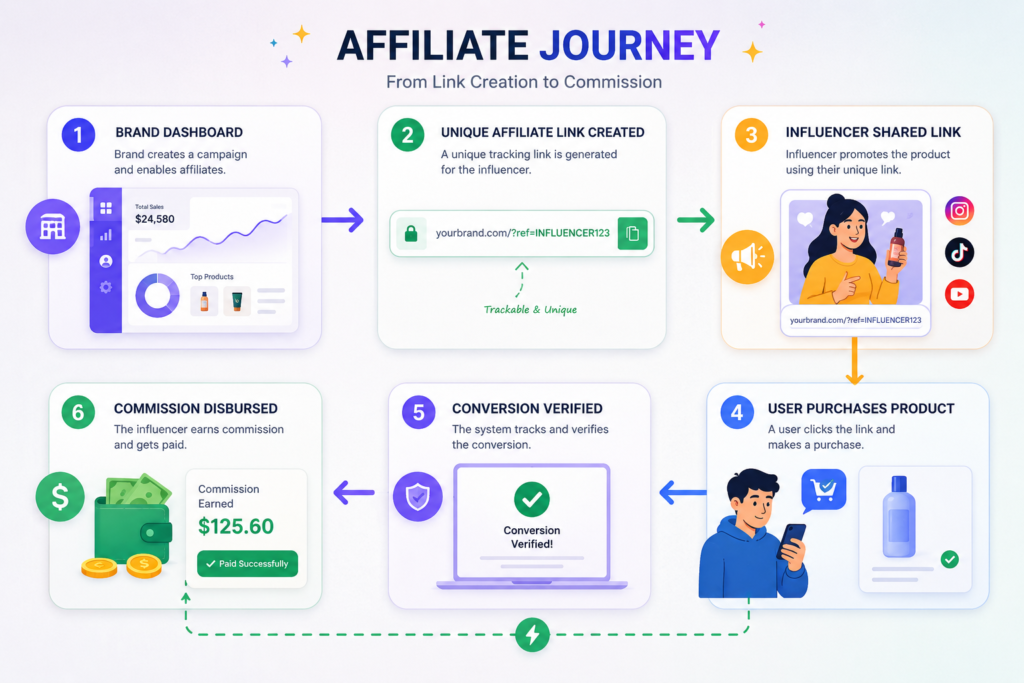
When an audience member interacts with that specific link, a tracking cookie is dropped into their web browser. This digital file maintains a predefined lifespan, commonly ranging from 24 hours to 90 days. If the consumer completes a qualifying transaction within that specific active cookie window, the attribution software logs the sale, verifies the parameters, and registers a contractually agreed commission to the influencer’s account balance.
The fundamental differentiator between affiliate infrastructure and traditional influencer marketing lies in this measurement metric. Traditional campaigns evaluate value using soft metrics like impressions, views, or general brand sentiment. Affiliate frameworks ignore audience size as a standalone value metric, prioritizing conversion velocity and actual transactional volume instead.
Consequently, a micro-influencer possessing 15,000 deeply dedicated followers within a specialized vertical can easily generate more affiliate revenue than a lifestyle creator with 400,000 passive followers. The commercial yield depends entirely on the alignment between the creator’s editorial focus and the commercial intent of their audience.
Why Affiliate Marketing Has Become So Important for Influencers
The modern media landscape requires creators to diversify their revenue to insulate themselves against platform volatility and sudden shifts in corporate ad spending. Relying solely on brand deals introduces severe financial vulnerability, as corporate marketing budgets fluctuate based on macroeconomic conditions, quarterly performance, and changing platform algorithms. Affiliate structures decouple a creator’s income from these external variables by establishing an independent, baseline revenue stream.
The core commercial benefit of affiliate infrastructure is its ability to generate evergreen revenue over long horizons. Standard social media sponsorships are transactional and time-bound, typically offering a single payout for a post that quickly disappears from algorithmic feeds. Well-structured affiliate content, by contrast, functions as a long-term income-generating digital asset.
Consider the compounding visibility lifecycle across specific media types. A comprehensive technical review uploaded to YouTube continues to surface in search results for years, capturing users exactly when they are researching a purchase. Similarly, a search engine optimized blog post targeting specific commercial queries can rank on Google’s first page, capturing organic traffic and generating commissions for months or years without requiring ongoing content production.
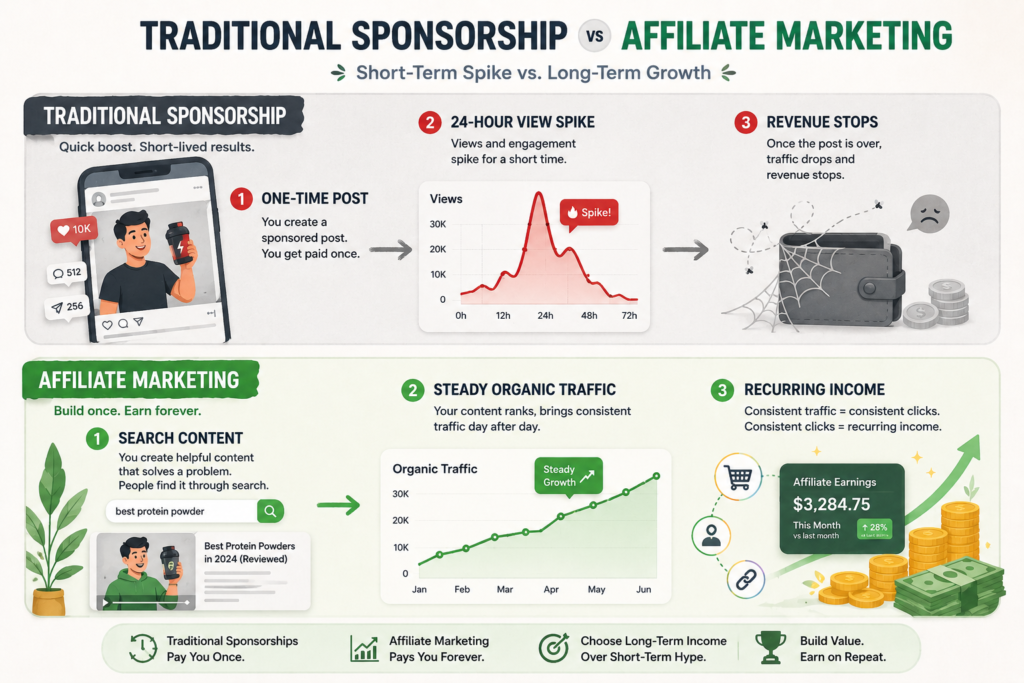
This structural longevity also applies to discovery engines like Pinterest, where visual pins can drive targeted traffic back to shoppable content indefinitely. Even automated email sequences can be configured to deliver product recommendations to new subscribers immediately upon joining, creating an automated monetization loop.
By building a library of high-utility, searchable content embedded with durable tracking assets, influencers can shift away from the constant content treadmill. This allows them to build a predictable financial foundation rooted in recurring commission cycles rather than relying on one-off brand negotiations.
How Affiliate Marketing Works for Influencers
The functional architecture of an affiliate campaign relies on a four-party network ecosystem in which each entity serves a specific operational purpose: executing, tracking, and validating transactions.
The Brand
The brand acts as the merchant of record and the creator of the underlying product or service. This entity handles all inventory management, product fulfillment, customer service, and post-purchase logistics. Merchants span various industries, from enterprise software providers and direct-to-consumer apparel houses to digital fitness brands, fintech applications, and major e-commerce marketplaces.
The Influencer
The influencer serves as the contextual distribution node within the ecosystem, utilizing specialized media channels to contextualize products for a dedicated audience. This group includes analytical long-form video creators, niche bloggers, short-form video strategists, audio broadcasters, and curated newsletter operators. Their primary role is translating raw product features into clear, real-world utility for their followers.
The Consumer
The consumer is the end user who interacts with the creator’s content and utilizes the tracking link to complete a transaction. Crucially, the consumer experiences no added cost when purchasing through an affiliate link. The product price matches standard retail rates, and any associated discount codes often provide an incentive to complete the transaction through the creator’s channel.
The Affiliate Platform
The affiliate platform functions as the neutral data engine and clearinghouse that manages tracking, attribution, and financial settlement. These specialized networks host the software that tracks impressions, clicks, and conversion data, providing transparent reporting to both brands and creators.
Several networks manage these enterprise relationships:
- Impact: Known for its precise contract automation and robust tracking capabilities with mid-market and enterprise brands.
- CJ Affiliate: A long-standing network featuring extensive global brand portfolios and advanced cross-device tracking systems.
- ShareASale: A division of Awin that offers accessible interfaces and a vast selection of merchant programs across diverse consumer verticals.
- Rakuten Advertising: A premium platform optimized for major retail brands, offering highly reliable tracking and international scale.
- PartnerStack: A specialized network built specifically for B2B software ecosystems, managing complex recurring subscription attribution.
Types of Affiliate Marketing Influencers Use
Affiliate compensation programs use distinct structural frameworks that dictate how conversions are verified and when payouts are triggered. Influencers choose programs based on their niche, content type, and audience behavior.
Pay-Per-Sale (PPS)
The pay-per-sale model is the standard framework across consumer retail and e-commerce ecosystems. Under this arrangement, an influencer receives a predetermined percentage of the gross transaction value, or a fixed dollar amount, only when a customer completes a full financial transaction.
For instance, if a creator showcases a premium camera priced at $1,200 through an e-commerce affiliate program carrying an 8% commission rate, a single validated purchase yields $96 in direct earnings. This model requires clear commercial intent from the audience, making it highly effective for deep-dive product reviews and unboxing content.
Pay-Per-Lead (PPL)
The pay-per-lead model shifts the conversion metric from a financial transaction to a verified user acquisition event. Influencers earn a fixed commission when an audience member completes a specific, non-monetary action that populates a brand’s sales pipeline.
Common PPL triggers include:
- Submitting a comprehensive inquiry form for a B2B service.
- Registering a validated user account on a financial platform.
- Enrolling in a software platform’s free trial layer.
- Requesting a formal insurance or refinancing quote.
This structure lowers the barrier to entry for consumers since no immediate payment is required, allowing influencers with high-trust informational content to maintain strong conversion rates.
Recurring Commissions
The recurring commission model is prominent within the Software-as-a-Service (SaaS) and digital subscription sectors. Instead of paying a single upfront commission, brands pay the affiliate an ongoing percentage of the customer’s subscription fee for as long as they remain a paying user.
If a technology influencer recommends an email marketing tool that charges $100 per month, a 30% recurring commission structure yields $30 every month from a single referral. As an influencer accumulates dozens or hundreds of active referrals, these individual payments compound into a highly predictable, compounding monthly revenue stream.
Why Brands Love Influencer Affiliate Marketing
Enterprise marketing strategies have shifted significantly toward performance-driven partnerships because they substantially reduce risk compared to traditional advertising methods. Upfront ad expenditures on programmatic displays or unverified influencer sponsorships offer no guarantee of baseline sales, frequently resulting in inefficient customer acquisition costs (CAC).
Affiliate structures transform these variable marketing risks into predictable performance costs. Because commissions are paid only after a transaction is verified, brands protect their profit margins and ensure a positive return on ad spend (ROAS).
This approach lowers customer acquisition costs by leveraging the pre-existing audience trust that influencers have spent years building. Rather than spending heavily on cold audience targeting, brands use the creator as an authentic filter, reaching highly receptive consumer segments at scale.
Furthermore, these partnerships provide deep analytical clarity. Modern tracking systems let brands monitor consumer journeys down to specific click paths and time-to-purchase metrics. This granularity enables enterprise marketing teams to optimize their budgets, scale top-performing creator relationships, and scale down underperforming campaigns with complete data-driven certainty.
The Most Successful Affiliate Content Formats
The highest-earning affiliates structure their content around high-intent decision moments, guiding consumers who are actively researching products rather than casually browsing. Certain format frameworks consistently drive the strongest conversion velocities.
Product Reviews
Comprehensive product evaluations capture consumers at the bottom of the purchasing funnel, exactly when they are seeking final confirmation before buying. Effective reviews avoid generalized praise, focusing instead on objective breakdowns, performance data, and real-world durability tests.
A deep-dive analysis of an enterprise project management tool or a technical breakdown of a mirrorless camera lens addresses specific user questions. This establishes clear utility and naturally leads to an affiliate link click.
Comparison Articles
Comparison assets capture search traffic from buyers who have narrowed their choices down to a few options but need help making a final decision. These pieces evaluate competing products using clear, side-by-side criteria.
- Direct Versus Analysis: Directly contrasting two major industry competitors, such as evaluating the features and infrastructure of one host provider against another.
- Categorical Groupings: Compiling specific tools tailored to a precise demographic, such as analyzing the top accounting platforms for independent e-commerce businesses.
These comparison breakdowns provide clear, structured information that helps consumers choose the product that best fits their specific needs.
Tutorials and Workflow Guides
Tutorial content drives conversions by showing a product in action within a real-world workflow. Rather than simply describing a tool, creators show exactly how to use it to solve a specific problem.
A step-by-step video showing how to color grade video footage using a specific editing software plug-in serves as a practical demonstration. When viewers see the tool solve a technical problem in real time, it provides clear proof of value, making them more likely to purchase through the accompanying link.
Resource Pages
A dedicated resource center acts as a permanent directory of the tools, software, and equipment an influencer relies on to run their business.
This curated directory functions as a trusted guide for an audience. Because it is framed as a foundational toolset rather than an active sales pitch, it drives consistent, long-term traffic and stable recurring commissions.
Read More: What is Content Marketing: Empower the Businesses and Brands
How Influencers Build Trust and Increase Affiliate Revenue
Long-term success in affiliate monetization depends entirely on maintaining audience trust. Audiences quickly recognize superficial promotions, and pushing poor products for short-term commissions can permanently damage a creator’s reputation.
Rigorous Personal Verification
High-performing affiliates test and verify products personally before introducing them to their audience. This direct experience allows creators to speak with authentic authority, sharing specific details that cannot be found on a brand’s standard product page.
When an influencer shares original imagery, custom datasets, or specific project files created with a tool, it proves they actually use it. This transparency builds credibility and naturally leads to higher conversion rates.
Balanced Critiques
Authentic recommendations require objective analysis. Experienced creators highlight a product’s limitations alongside its benefits, ensuring their audience gets a complete, realistic picture.
To maintain a balanced approach, it helps to structure critiques around clear operational realities:
- Identify Target Audiences: Clarify who the product is actually for and who should avoid it based on its features.
- Highlight Functional Trade-offs: Discuss where a product falls short, such as a software tool having a steep learning curve despite its powerful features.
- Provide Lower-Cost Alternatives: Recommend budget-friendly options for beginners who may not need a premium, high-priced tool.
Clear Disclosure Practices
Maintaining transparency is both an ethical practice and a regulatory requirement. In the United States, the Federal Trade Commission enforces strict guidelines regarding commercial relationships. Influencers must disclose affiliate links clearly and conspicuously, ensuring the disclosure sits close to the point of recommendation.
Beyond legal compliance, clear disclosures actually build audience trust. Informing viewers that a link supports the channel at no extra cost fosters transparency and encourages followers to intentionally use the affiliate link to support the creator’s work.
Affiliate Marketing vs Sponsored Content
While many creators use both monetization strategies, affiliate marketing and sponsored content operate on completely different financial and operational frameworks.
| Operational Dimension | Affiliate Marketing Framework | Sponsored Content Framework |
| Compensation Architecture | Performance-based commission model paid out post-conversion. | Fixed upfront fee paid regardless of campaign performance. |
| Revenue Longevity | Generates evergreen returns from content archives for months or years. | Typically, a one-time payout is tied to an initial publication cycle. |
| Brand Risk Profiles | Low financial risk for brands as spend maps directly to sales. | Higher upfront risk for brands with no guaranteed conversion volume. |
| Income Predictability | Variable monthly returns that scale with search traffic and trust. | Highly predictable flat-rate pricing based on contract terms. |
| Scalability Drivers | Driven by conversion optimization and deep search intent. | Dependent on total audience reach and impression metrics. |
Integrating both models allows creators to build a balanced revenue strategy. For example, an influencer can use an upfront sponsorship fee to cover immediate production costs, while using embedded affiliate links to secure long-term, compounding returns over time.
How Affiliate Marketing Is Evolving Across Content Platforms
The affiliate landscape shifts continuously alongside changes in social media algorithms, consumer habits, and digital commerce infrastructure.
The Rise of Micro-Authority
Brands are shifting their focus away from massive follower counts toward micro- and nano-influencers who possess deep authority within specific niches. Audiences in these smaller communities often interact more closely with creators, viewing their recommendations as trusted advice from a peer rather than a commercial ad. This close relationship frequently drives much higher conversion rates than those achieved by larger, more generalized lifestyle creators.
Shorter Paths to Purchase
Social commerce platforms are removing friction from the buying process by integrating affiliate tracking directly into social feeds. Features like native shoppable video tags allow users to discover a product, click an affiliate tag, and complete their purchase without ever leaving the app. This seamless process reduces drop-off rates and helps creators convert casual viewers into customers much faster.
Personal Insight Over Automated Summaries
As search engines and social feeds become crowded with generic, AI-generated content, audiences are actively seeking out authentic personal experiences. Buyers want to hear from real people who have actually tested a product in real-world conditions. Affiliate strategies that lean into unique personal insights, original data, and hands-on testing are outperforming generic product summaries across both search engines and social platforms.
Common Mistakes New Influencers Make
Building a sustainable affiliate business requires avoiding several common traps that can stall growth and alienate audiences.
Over-Saturation of Offers
Promoting too many competing products destroys a creator’s credibility. Jumping from one software platform or apparel brand to a direct competitor within the same week signals to the audience that the recommendations are driven by commission rates rather than genuine preference. Creators should select a few high-quality tools within their vertical and stick with them consistently.
Chasing High Payouts Instead of Quality
Recommending a low-quality product simply because it offers a high commission rate is a short-sighted strategy that damages audience trust. If a follower buys a recommended product and has a poor experience, they are unlikely to trust any future recommendations. Long-term profitability relies on repeat conversions, which requires prioritizing product quality over immediate payout sizes.
Neglecting Audience Context
An affiliate offer must match the specific needs and financial realities of a creator’s audience. For example, pitching a premium, enterprise-grade software subscription to a community made up of hobbyists or student creators will rarely drive conversions, no matter how good the product is. Recommendations must align with the audience’s current skill levels and budgets.
Focusing on Sales Over Support
Content designed solely to make a sale rarely performs well over time. The most effective affiliate marketers focus on being helpful first and selling second. Content should prioritize educating the audience, solving their problems, and answering their questions. When a creator focuses on delivering genuine value, affiliate conversions follow naturally as a helpful byproduct.
Strategic Blueprints for Long-Term Success
To transform affiliate marketing from a casual side income into a sustainable, scalable business, creators need to shift from passive link-sharing to building a structured system. This means treating every product recommendation as a core part of their broader editorial strategy. Content should be organized into clear, multi-platform pathways that meet buyers at different stages of their decision-making journey, combining quick social media demonstrations with deep-dive, searchable reference guides.
Ultimately, the creators who build the most profitable affiliate channels are those who view themselves as trusted industry experts for their audience. By prioritizing rigorous product testing, maintaining honest and balanced critiques, and keeping their content highly aligned with audience needs, influencers can build a highly resilient revenue engine that grows alongside their community.