The playbook for small-business growth has been rewritten over the last two decades. Before mainstream networks took over the internet, a local business faced severe geographical and financial constraints. Reaching a neighborhood or a city required capital for print flyers, newspaper columns, local radio spots, or physical billboards. These channels required upfront capital, locked businesses into rigid contracts, and offered zero data on who actually saw the message.
Today, digital infrastructure allows a backyard business or a niche software startup to compete for the same consumer attention as a multi-million dollar corporation. By using platforms like Instagram, LinkedIn, TikTok, and YouTube, small brands bypass traditional media gatekeepers entirely.
The true impact of this shift is not just about cheaper ad space. It has fundamentally changed how small businesses establish credibility, handle customer service, and build long-term enterprise value. For the modern entrepreneur, these platforms function as an operational core that handles everything from initial brand discovery to direct commerce.
The Shift from One-Way Advertising to Two-Way Communication
Traditional marketing functioned exclusively as a broadcast medium. A business paid to place a message in front of an audience, and the consumer consumed it passively. If a customer had a question, a complaint, or a compliment, the feedback loop was slow, private, and often entirely broken.
Social media replaced this model with an immediate, public, two-way dialogue. Consumers now expect to interact with brands the same way they interact with their friends.
The new customer journey involves:
- Leaving public feedback on posts
- Asking pricing or availability questions via direct comments
- Sending instant direct messages for personalized assistance
- Sharing unboxing experiences or service reviews publicly
- Tagging businesses in peer-to-peer recommendations
This transformation favors small businesses over massive corporate entities. Large corporations face structural layers, compliance delays, and automated response bots that strip away personality. A small business owner or a dedicated local manager can respond to a query in real time, injecting authenticity into the interaction.
When a local bakery responds to a customer within minutes, it builds a layer of brand affinity that a global conglomerate cannot easily replicate with a massive ad budget. Marketing is no longer about shouting at an audience. It is about maintaining a continuous, helpful conversation.
Increased Brand Visibility Without Massive Budgets
The democratization of reach means that creative, high-utility content can outpull a poorly conceived paid campaign. Algorithms across major video and photo platforms prioritize user watch time and engagement over the follower count of the account posting it.
This environment allows small businesses to generate massive awareness by focusing on a few specific content styles:
- Educational content that solves a specific customer pain point
- Transparent, behind-the-scenes looks at how products are manufactured or sourced
- Narrative-driven stories about the founders or the local community
- Real-time participation in relevant industry discussions or cultural moments
Blendtec
A classic case study in this democratization of attention is Blendtec. The industrial blender manufacturer did not rely on traditional prime-time television slots to launch its consumer line. Instead, the company created the simple, low-budget video series called Will It Blend?, where they blended everything from glow sticks to smartphones.
The campaign generated millions of organic views, established the absolute durability of the product, and directly drove a 700% increase in retail sales over a multi-year period. It proved that a highly engaging, raw demonstration could completely outperform multi-million dollar creative agency campaigns.
Social Media Has Made Customer Trust More Transparent
In the past, a small business built trust through decades of local presence or expensive credentialing. Today, consumer trust is crowd-sourced, real-time, and completely transparent. Before a consumer enters a local storefront or inputs their credit card on a website, they perform a digital audit of the brand’s social footprint.
Modern trust signals are determined by public indicators:
- The volume and sentiment of user comments under recent posts
- Real-time user-generated photos and videos tagging the business
- Unfiltered customer reviews and star ratings on integrated platform business profiles
- The speed and tone of the brand’s replies to public criticism
This transparency is a massive asset for high-quality small businesses. When potential clients see a local roofing contractor posting daily updates of their work, replying to feedback, and hosting video testimonials from actual neighbors, the perceived risk of doing business drops to zero. A sterile corporate website with stock imagery can no longer compete with a highly active, socially verified local competitor.
Word-of-Mouth Marketing Became Digital
Peer recommendations have always been the most effective growth engine for small businesses. Social media has digitized this phenomenon, removing geographical limits and multiplying its velocity. A physical recommendation stays between two people. A digital recommendation can scale to thousands overnight.
When a customer is delighted by a small business, they amplify that experience across their personal networks by:
- Posting a photo of their meal or product unboxing to an Instagram Story
- Sharing a detailed text breakdown of a service provider’s work on Facebook
- Recording a quick video review for TikTok detailing how a product solved a problem
This creates a continuous loop of organic customer acquisition. The business no longer has to hunt for every single lead. Instead, their existing client base acts as a distributed sales force, introducing the brand to highly qualified, lookalike audiences who trust the recommendation because it comes from a friend, not an advertisement.
Hyper-Targeted Advertising Changed the Game
The most radical commercial shift brought by these platforms is the precision of paid distribution. Traditional media forced small businesses to pay for massive, wasted reach. A local plumbing company buying a spot on a regional radio station paid for every listener, even if only 2% of them actually needed plumbing work at that moment.
Modern advertising suites allow businesses to filter out irrelevant audiences entirely. Budgets can be deployed exclusively toward individuals who meet exact demographic, behavioral, and geographic criteria.
Small businesses can now build highly custom ad parameters based on:
- Micro-locations down to specific zip codes or a one-mile radius around a storefront
- Explicit user interests, hobbies, and digital media consumption habits
- Specific life events such as a recent engagement, a home purchase, or a career change
- Professional job titles, industry verticals, and company sizes on business networks
- Past purchase behavior and direct interactions with the company’s website
Consider the efficiency gain of this model. A local fitness center in downtown Austin can choose to display an ad exclusively to residents aged 25 to 45 who live within a ten-minute drive and have shown an active interest in functional weight training. A wedding photographer can target users whose relationship status changed to engaged within the past thirty days. This level of precision eliminates wasted spend, allowing a budget of five dollars a day to yield measurable, bottom-line returns.
Small Businesses Can Build Communities, Not Just Audiences
An audience is a passive group of spectators who listen to a single voice. A community is an interconnected network of individuals who talk to each other around a shared interest. Small businesses that leverage social platforms to build communities achieve far higher customer retention rates and lower lifetime acquisition costs.
To build these active communities, small brands utilize several native platform features:
- Private discussion groups dedicated to product support or industry-specific advice
- Branded hashtags that encourage users to share their own progress and photos
- Live interactive broadcasts where followers can ask questions and chat in real time
- User-generated content challenges that incentivize community-wide participation
When a consumer feels like they belong to a community, their relationship with the brand transitions from transactional to emotional. They stop shopping based purely on price and begin buying because of identity and alignment. For a small business, this community layer forms a defensive moat that larger competitors cannot easily penetrate with discounts or aggressive pricing strategies.
Customer Service Became a Marketing Channel
The boundary between support and marketing has completely dissolved. Consumers no longer want to wait on hold for a call center or send an email to a generic inbox. They turn to direct messages and comment sections for immediate resolution of their issues.
The platforms most frequently used for support inquiries include:
- Instagram and Facebook Direct Messages: For e-commerce tracking, product sizing, and local hours.
- X (formerly Twitter): For real-time updates and direct corporate escalation.
- Public Comment Sections: Used by consumers to gauge how responsive a company is before purchasing.
This shift presents a major branding opportunity. When a small business resolves an issue publicly, politely, and rapidly, every person browsing that page sees evidence of exceptional customer care. A helpful, empathetic response to a public complaint often does more to prove brand integrity than twenty pieces of polished marketing content. Customer service is no longer a hidden cost center. It is an active, public driver of brand loyalty.
The Rise of Influencer Marketing
The democratization of media created a new class of digital creators who hold immense trust within highly specific niches. Small businesses no longer need multi-million dollar budgets to secure traditional celebrity endorsements. Instead, they can partner with micro-influencers and nano-influencers who have deeply engaged, loyal followings.
Partnering with these creators offers small brands significant advantages:
- Higher Engagement Rates: Creators with fewer than 50,000 followers frequently see double the engagement of major celebrities.
- Niche Alignment: A local vegan skincare brand can partner with a local aesthetician creator, reaching an audience pre-qualified to care about the product.
- Cost Efficiency: Micro-influencers often collaborate in exchange for product, affiliate revenue splits, or modest content creation fees.
When a trusted niche creator recommends a product, their audience views it as a tip from a friend rather than a corporate ad. For a small business, a coordinated campaign with three or four highly targeted local creators can completely sell out an inventory run or book out a service schedule within days.
Real-World Examples of Social Media Success in the USA
The practical application of these strategies is best understood by looking at real businesses that used social platforms to scale from small concepts into major market forces.
Crumbl Cookies
A notable example of visual momentum is Crumbl Cookies. The brand transformed the traditional bakery model by leveraging TikTok and Instagram to turn its weekly flavor rotation into a viral event. By using high-definition, close-up video clips of their cookies being broken open, they created an algorithmic demand curve. This short-form video strategy propelled a single Utah bakery into a massive national franchise network driven almost entirely by organic consumer anticipation.
Beardbrand
In the men’s grooming space, Beardbrand built its entire global customer base by prioritizing education over sales. The founder started posting high-utility styling, trimming, and maintenance tutorials on YouTube long before launching an extensive product line. By establishing authority and helping men solve real grooming issues for free, they built a highly trusting audience that naturally turned into a multi-million dollar e-commerce customer base when the physical product line launched.
The Pink Stuff
Though manufactured globally, cleaning paste The Pink Stuff saw its entry into the United States market explode due to the #CleanTok phenomenon on TikTok. Unsponsored creators began filming dramatic transformations of stained ovens, dirty tile grout, and rusted cookware using the product. These raw, user-generated videos went viral, creating a massive supply shortage in retail stores across the country. The brand grew because the visual proof of the product’s efficacy was communicated entirely by real consumers.
How Social Media Changed Local Marketing
For brick-and-mortar businesses, social platforms have completely replaced old physical directories. A local service provider or retailer no longer relies solely on foot traffic or drive-by visibility. They can actively project their presence into the smartphones of everyone living within their immediate service territory.
Local businesses optimize their regional presence by executing a few core tactics:
- Geotagging every post and story with specific neighborhood names or city centers
- Running hyper-local promotions tied to community events or high school sports matches
- Encouraging check-ins and real-time photo uploads from patrons inside the physical establishment
- Showcasing the real staff members who interact with clients face-to-face daily
This localized approach allows neighborhood service providers like dental clinics, real estate agencies, boutique gyms, and general contractors to build deep local awareness. They become familiar faces in the community before a prospect ever speaks to them, making the eventual sales process smoother and highly efficient.
The Emergence of Social Commerce
The customer journey used to be a multi-step pipeline. A consumer discovered a product on a social feed, clicked a link to an external website, navigated a checkout funnel, and manually entered their payment data. Every step in that process introduced friction, leading to abandoned shopping carts and lost revenue.
Social commerce removes these hurdles by turning social applications directly into digital storefronts. Consumers can browse collections, view real-time inventory, and complete an encrypted checkout without ever exiting the app.
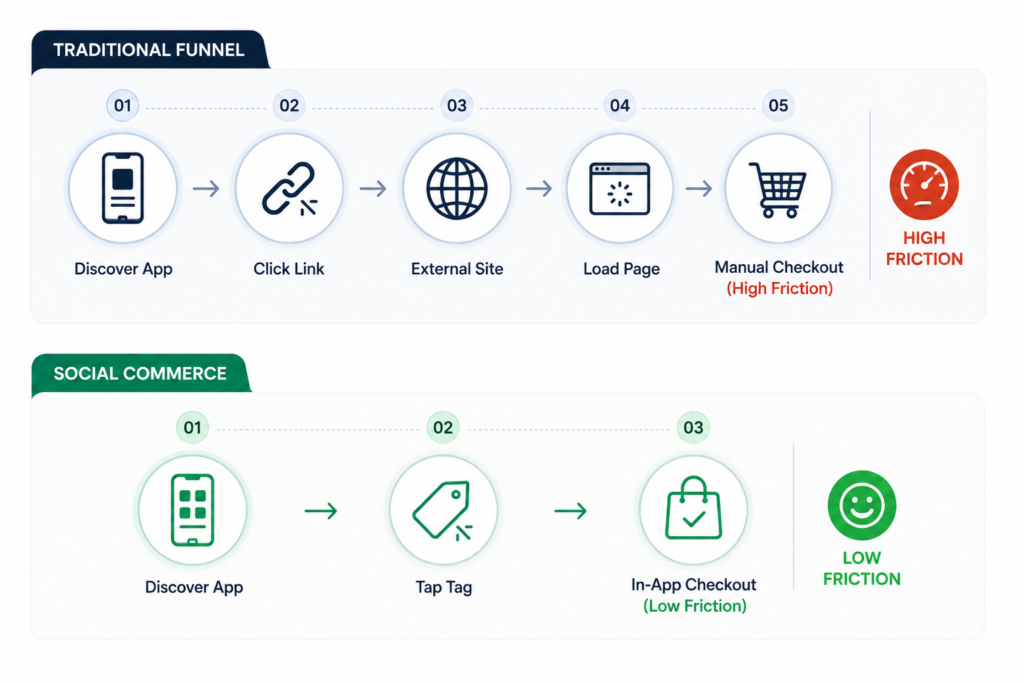
For small businesses, this integration levels the playing field significantly. Native shopping features allow a boutique brand to offer the same seamless, single-tap checkout experience as an enterprise retailer.
By eliminating the technical barriers of external web design and payment processing, small brands drastically compress the timeline between initial product discovery and completed conversion.
The Growing Importance of Video Content
Static imagery and text-only updates no longer command significant real estate on modern algorithmic feeds. Short-form, vertical video serves as the primary engine for organic reach and user engagement.
The underlying distribution systems are built to reward viewer retention and watch time, which means that a compelling video recorded on a basic smartphone can easily outperform a glossy, highly produced corporate graphic.
Small businesses can utilize video content effectively across several distinct frameworks:
- Product Demonstrations: Showing a product solving a real problem in real time.
- Tutorials and Explanations: Sharing free, actionable expertise that establishes industry authority.
- Behind-the-Scenes Access: Introducing the actual employees, packing processes, or sourcing methods to humanize the company.
- Customer Frequently Asked Questions: Addressing common sales objections or inquiries directly on camera.
This emphasis on video allows small businesses to project their unique brand personality. While large corporations often require weeks of legal approvals and creative reviews to produce a single clip, a small business owner can spot an industry trend, record a quick response, and reach thousands of prospective buyers within an afternoon.
How AI Is Changing Social Media Marketing
Artificial intelligence has shifted from an enterprise luxury to an accessible, everyday utility for small business operations. Modern tools allow lean marketing teams or solo operators to scale their creative output and handle advanced data analysis without hiring outside agencies.
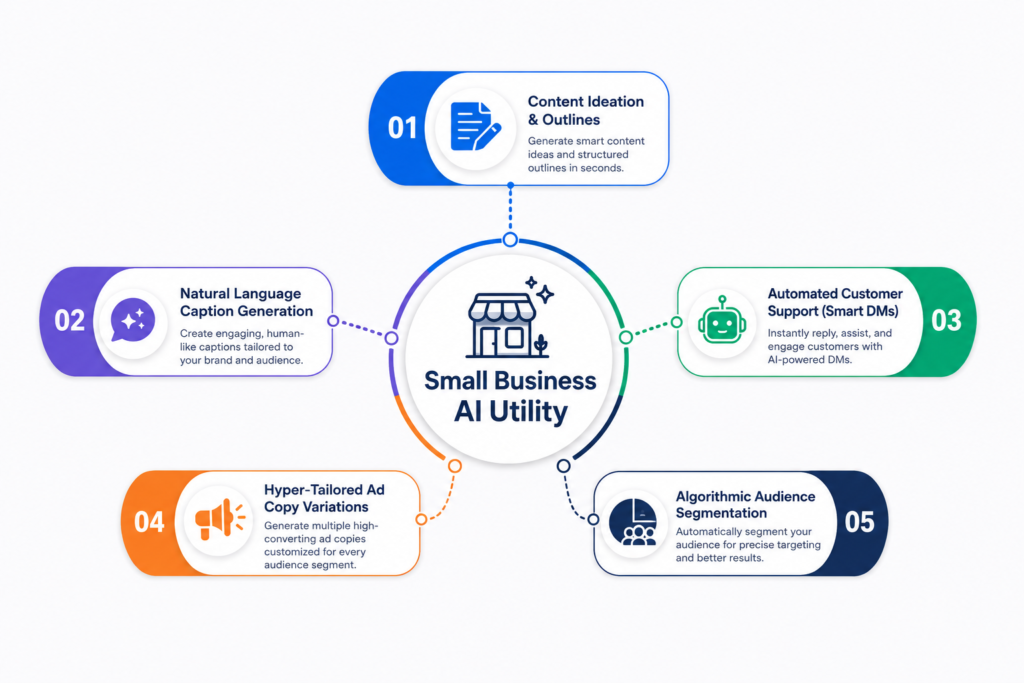
A major operational benefit lies in automated customer engagement. Platforms like Meta have expanded advanced AI tools that manage initial direct inquiries, qualify incoming sales leads, and resolve basic tracking questions around the clock.
When a customer messages a bakery at midnight asking about custom gluten-free options, an integrated AI assistant can immediately provide the menu, gather the user’s email, and queue the conversation for the morning staff.
The real advantage does not go to those who automate everything blindly. It goes to the small businesses that use AI to handle administrative efficiency, background research, and structural data analysis, while keeping their client-facing communication deeply human, authentic, and specific.
Key Social Media Trends Small Businesses Should Watch
Navigating the next phase of digital growth requires adapting to several structural shifts in consumer behavior and platform architecture.
The Rise of Social Search
Younger demographics increasingly bypass traditional web browsers when searching for local services, product reviews, or dining recommendations. They treat search bars on apps like TikTok and Instagram as visual search engines.
A small business must optimize its profiles by treating captions, location tags, and video text fields like traditional keywords to ensure they surface when users search for terms like best coffee shop near me or independent auto repair. To strengthen online visibility across multiple channels, many businesses also invest in search engine marketing strategies that complement social search optimization.
Creator-Led Commerce
The nature of influencer marketing has evolved from mere visibility to direct commercial impact. Consumers are deeply skeptical of broad, celebrity-style sponsorships. They align their spending habits with micro-creators who possess verifiable expertise in narrow fields.
Small brands achieve the highest returns by partnering with these niche authorities who can seamlessly demonstrate a product’s utility to a highly receptive, trusting audience.
Engagement Over Follower Counts
The old metric of chasing massive follower totals is largely obsolete. Platform algorithms prioritize how active, loyal, and responsive an existing audience is.
A small business with 2,000 highly engaged followers who comment, share, and buy will see far greater organic distribution than an account with 20,000 passive, unengaged followers. Quality of interaction dictates reach.
Common Mistakes Small Businesses Still Make
Despite the unprecedented access to consumer markets, many small enterprises fail to see a positive return on investment because they fall into predictable strategic traps.
Treating Social Media as a Billboard
The absolute quickest way to tank user engagement is to post nothing but promotional sales pitches. Social platforms are transactional environments only after value has been established. If an account consists entirely of graphics saying Buy Now or Special Offer, users will unfollow or scroll past. The optimal approach is to focus on educating, entertaining, or helping the viewer first.
Chasing Every Single Platform Trend
Many business owners stretch their limited resources thin by trying to maintain an active presence on every single trending application simultaneously. It is far more profitable to master one or two channels where the target demographic spends the majority of its time than to publish low-quality, inconsistent content across five different networks.
Ignoring the Analytics
Operating without regular data review leads to wasted budget and effort. Small businesses often look at vanity metrics like total likes instead of tracking core indicators:
- Direct click-through rates to shopping carts or booking pages
- Total inbound lead volume generated via direct messages
- Audience retention rates on video content to see exactly when viewers drop off
- Conversion rates on specific hyper-local ad campaigns
Final Thoughts
The democratization of digital marketing tools has permanently removed the old barriers to entry. Competing with an enterprise-level competitor no longer requires matching their million-dollar television or print budget.
Success belongs to the nimble, authentic small business that can leverage targeted visibility, rapid short-form video explanation, and deep community interaction to build unshakeable customer trust.
Social platforms should not be viewed as an optional, secondary task handled only when time permits. They function as the direct operational link to the modern marketplace. The small businesses that invest in consistent, high-utility content and genuine peer-to-peer communication will continue to capture market share, build defensible local brand equity, and generate sustainable long-term commercial growth.
Frequently Asked Questions
How has social media changed marketing for small businesses?
It transitioned marketing from an expensive, one-way broadcast model into a highly affordable, two-way conversational system. Small businesses can now precisely target exact demographics, manage public customer support, and capture sales directly within the applications where their buyers spend their time.
Which social media platform is best for small businesses?
The ideal platform is entirely dependent on where the specific target customer profile aggregates. Visual, consumer-facing brands find immediate success on Instagram and TikTok; professional business-to-business (B2B) services thrive on LinkedIn; local service providers rely heavily on Facebook’s community structures; and brands requiring deep educational proof perform best on YouTube.
Is social media marketing still effective?
Yes, it remains a primary driver of organic discovery and paid lead generation. However, success requires moving away from overly polished corporate ads and leaning into raw, short-form video content, community engagement, and the strategic use of AI tools to manage customer communications.
Can small businesses compete with large brands on social media?
Absolutely. Algorithms prioritize content relevance, watch time, and user interaction over the size of the company posting it. A creative, rapid-response small business that interacts personally with its audience can easily outpace a rigid, slow-moving corporate entity.
What is the biggest benefit of social media marketing for small businesses?
The ability to build direct, authentic relationships with a highly targeted audience at a fraction of the cost of traditional advertising media. It allows a business to build a loyal community that acts as an organic sales force through digital word-of-mouth.