

Software rarely becomes difficult because it grows large. It becomes difficult because its parts gradually become dependent on one another in ways that were never intended. When a pricing change affects checkout, checkout affects inventory, and inventory affects reporting, every modification becomes a massive, coordinated effort across multiple teams. The real challenge is not the complexity of the features themselves, but how that complexity permeates the entire system.
Designing software with a decoupled architecture is a deliberate attempt to contain that spread. It is less about choosing specific microservices, cloud platforms, or API frameworks and more about making structural decisions that allow one part of a system to evolve without forcing every other part to change in lockstep.
Software Ages Through Dependencies
The initial version of most applications is easy to grasp because responsibilities are clearly defined and dependencies are sparse. As products mature, new requirements are frequently grafted onto existing components rather than implementing better, more isolated boundaries. Over time, business logic accumulates, integrations multiply, and architectural assumptions begin leaking across the entire codebase.
This is why mature systems often feel fragile. Developers hesitate to modify code because they lack visibility into what else depends on it. Release cycles grow slower, testing becomes exponentially more expensive, and architectural discussions shift from building new capabilities to simply avoiding regressions.
Good architecture recognizes that software is in a constant state of flux. Instead of optimizing only for today’s features, a professional approach minimizes the cost of tomorrow’s inevitable changes. This requires a shift in mindset where maintainability is treated as a first-class requirement.
Find the Right Boundaries Before Choosing Technologies
Architectural boundaries must reflect business capabilities rather than technical layers. Technologies like databases and front-end frameworks change, but core business functions like order management, payments, and inventory remain stable pillars of the organization.
When these responsibilities are mixed together simply because they participate in the same workflow, unrelated changes begin to affect one another. Finding these boundaries requires a deep understanding of the business domain. Service diagrams are trivial to draw, but identifying stable, independent business responsibilities is considerably harder and requires significant domain expertise.
Poorly defined boundaries rarely fail immediately. They become prohibitively expensive years later when every enhancement requires touching multiple components that should never have been coupled in the first place. You must prioritize the definition of these domains before you ever commit to a specific infrastructure or deployment model.
Decoupling Is About Dependencies, Not Deployment
A common misconception is that distributed systems are automatically decoupled. They are not. A well-structured monolithic application with disciplined module boundaries is often significantly easier to evolve than dozens of microservices that are constantly waiting for synchronous responses from one another.
Separating the front-end from the back-end improves deployment flexibility, but it does not guarantee architectural independence. The real metric is whether a business capability can change without requiring coordinated modifications across the rest of the ecosystem.
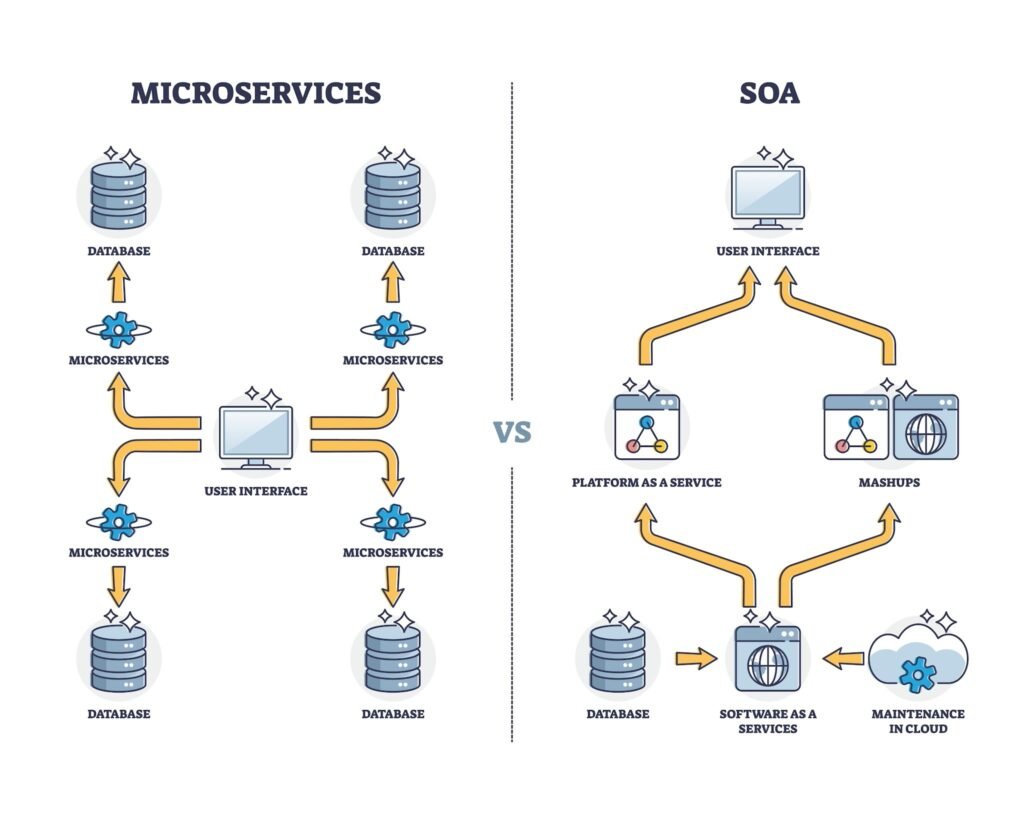
If replacing a single payment provider requires updates across reporting, customer management, and inventory, the architecture remains tightly coupled regardless of how many individual services exist. Technology choices influence your architecture, but they do not define it. True decoupling is an organizational and structural victory, not an infrastructure one.
Read More: What Is Software Development? Processes, Tools, and How It Really Works
Independent Components Still Need to Collaborate
Decoupling does not mean cutting off communication. Instead, it changes the fundamental design of how information flows through your system. Many engineers default to synchronous request-response cycles for every interaction, which inadvertently creates a fragile chain of runtime dependencies. If your checkout process blocks while waiting for an inventory check, a shipping update, and a rewards points calculation, you have created a single point of failure that spans your entire infrastructure.
A more mature approach involves distinguishing between immediate operational needs and downstream side effects. If a user is actively waiting for an action to complete, like authorizing a credit card, a synchronous call is appropriate. However, non-critical tasks such as updating analytics, sending confirmation emails, or triggering loyalty rewards should be handled as asynchronous events. By allowing downstream processes to consume these events at their own pace, you build a system that is resilient to temporary service degradation.
Crucially, the focus must remain on interface stability. Consumers should depend on the business capability you provide, not the internal implementation details or the current database schema of your service. Well-defined contracts and rigorous versioning allow you to iterate on your internal logic without forcing every other team in the company to rewrite their integrations.
Data Is an Architectural Boundary
Many developers believe they are building a decoupled system because they have split their code into separate services, yet they keep a single, massive, shared database. When multiple services share the same tables, the database effectively becomes the only architecture that exists. A change to a single schema column in the order table can unexpectedly crash your reporting engine, your customer analytics, and your billing integration simultaneously.
This is why true architectural independence requires data ownership. Each business capability must own its data and strictly guard access to it.
- Encapsulation: No service should perform direct cross-database joins on tables it does not own.
- Interface-Driven Access: If a service needs data held by another, it must request it through an API or a data stream.
- Eventual Consistency: Accept that perfect synchronization is rarely necessary. Most business processes operate effectively with eventual consistency, which removes the need for distributed transactions and heavy locking mechanisms.
By allowing each domain to manage its own internal data models, you gain the freedom to optimize storage based on specific needs. One service might use a relational database for consistency, while another uses a document store for performance, all without affecting the rest of the system.
Read More: What Is Data Security? How Organizations Protect Sensitive Data
Design for Continuous Change
Systems should mirror the rate at which different parts of your business actually evolve. Pricing strategies might shift monthly due to market pressure, whereas core regulatory compliance rules might only change annually, and basic customer identity models could remain static for decades.
Treating every component as equally flexible often creates immense, unnecessary overhead. Architects who succeed in the long term identify these varying rates of change and design extension points exactly where they are needed, while preserving rigidity in stable areas.
- Stabilize the Foundation: Reserve your most conservative design patterns for modules that are unlikely to change.
- Prepare for Volatility: For areas expected to shift, prioritize patterns like strategy or provider-based designs that allow for feature toggling or rapid replacement.
Successful systems do not try to predict the future with perfect accuracy. They succeed because their internal structure accommodates change without requiring a total redesign. By building components that are easy to swap out, you ensure the platform remains maintainable even as business priorities shift.
Read More: What Is Website Development? Process, Types, and How to Get Started
Independence Has a Cost
Autonomy is highly valuable, but it is never free. Transitioning to a distributed, decoupled architecture introduces specific engineering trade-offs that must be managed. You are effectively trading the relative simplicity of a centralized system for the operational complexity of a distributed one.
When you move components into independent services, you are no longer operating in a safe, memory-shared environment. You must account for network partitions, service discovery, distributed tracing, and the inevitable reality of partial failures. Data consistency is no longer a database-level guarantee but an application-level decision that requires rigorous design.
These are not flaws of the decoupled approach; they are the objective costs of independent evolution. A senior architect evaluates whether these costs solve a genuine business problem. Do not adopt a decoupled strategy simply because it is trending in the industry. Earn your independence by ensuring that the freedom to deploy and scale is generating measurable value that outweighs the operational burden of the infrastructure required to support it.
Architecture Reflects the Organization
Software boundaries and organizational boundaries are inextricably linked. This is a core principle known as Conway’s Law, which states that systems are constrained by the communication pathways of the people who build them. If your organization is structured in rigid silos, your software will inevitably mirror that friction.
To achieve meaningful decoupling, you must align your team structure with your domain boundaries. When a single team possesses the authority and responsibility for the full lifecycle of a business capability, they deliver changes with far greater velocity than a team that must coordinate with five other groups for every release.
- Domain Ownership: Align teams around business outcomes rather than technical tiers like database, API, or frontend.
- Communication Reduction: If a release requires a massive planning meeting involving multiple department leads, your architecture is likely too tightly coupled for the organization to move quickly.
- Autonomy: Clear technical boundaries are only effective if teams have the autonomy to make decisions within their domain without needing external approval.
Know When Not to Decouple
A common architectural error is decomposing software before the problem requires it. Many startups fall into the trap of adopting complex distributed architectures long before they face the scale or organizational pressure that justifies the operational cost. The result is often an explosion of infrastructure overhead without any corresponding increase in business value.
A modular monolith with disciplined boundaries often provides a much stronger foundation for early and mid-stage products than prematurely introducing dozens of microservices. Simplicity should not be viewed as a temporary compromise to be fixed later; it is a legitimate, high-level architectural objective. The goal of decoupling is not to maximize the number of independent components, but to reduce unnecessary friction while keeping the system understandable and easy to maintain.
Architecture Is an Ongoing Design Process
No architecture remains correct indefinitely. Business models evolve, technologies hit their end-of-life, and team requirements shift. A successful system responds to this reality through continuous, incremental refinement rather than the dangerous, high-risk path of a wholesale platform rewrite.
True decoupling is a commitment to preserving options. By building with well-defined boundaries and clear, versioned interfaces, you retain the ability to replace internal components as the business changes. You are not building a static monument; you are designing a flexible, evolutionary system.
The ultimate metric of a decoupled architecture is how easily you can modify the system to meet the challenges of tomorrow. Systems built with this objective remain maintainable not because they avoid complexity, but because they prevent that complexity from spreading beyond the specific boundaries where it belongs.