
Search engine optimization and email marketing often live in completely different silos within digital departments. One channel focuses heavily on pulling fresh, targeted traffic to a website through search engines, while the other builds a direct line of communication to keep an existing audience engaged.
Viewing these two practices as entirely independent channels is a missed opportunity. They operate as complementary forces where discovery and retention work together. Search engine optimization handles the initial introduction to your content, and email marketing ensures that the same content continues producing measurable value long past its original publication date.
When professionals type the phrase ahrefs how email marketing impacts seo into a search bar, they are typically looking for a direct answer regarding whether running a newsletter will move their articles higher on a search engine results page. The short answer is no. Search engines do not evaluate inbox activity, click-through rates, or email subscriber growth when calculating where a page belongs in search results. However, email marketing actively feeds into the broader ecosystem that drives organic success by expanding content reach, generating returning traffic, lifting brand awareness, and uncovering natural backlink opportunities.
Instead of keeping these channels isolated, businesses achieve far better efficiency when they align them. Organic search serves as a powerful mechanism for fresh audience acquisition, feeding the top of the marketing funnel. Email marketing then steps in to nurture those new relationships, pulling visitors back to the site to consume fresh resources, explore services, or complete transactions.
What Ahrefs How Email Marketing Impacts SEO Actually Means
The intent behind looking up Ahrefs on how email marketing impacts seo is rarely about a hidden integration or a specific tool feature inside the Ahrefs dashboard. Ahrefs is widely recognized as a premium platform built for keyword analysis, tracking backlink profiles, studying competitor movements, and running deep content audits. It does not send emails, nor does its data suggest that email delivery alters algorithmic rankings. The phrase instead represents a search for how an optimization platform can inform a distribution strategy.
Using a data platform like Ahrefs takes the guesswork out of determining what information your subscribers actually want to read. Rather than choosing newsletter topics based on a hunch, marketers can look at hard search data to see what is already pulling in traffic, what topics are rising in market interest, and which pages have proven business utility.
An optimization platform provides clarity on content performance by showing:
- Which specific guides draw the highest volume of consistent organic traffic
- Which older resources possess strong search demand but require updates before a re-promotion
- Which pages are successfully attracting links from external industry websites
- Which target keywords represent the highest commercial value for the business
Consider a practical example where a software provider publishes an exhaustive guide addressing software integrations. Through regular tracking, the marketing team notices via their analytics that the guide has successfully reached the first page for a highly competitive industry phrase. It pulls steady traffic every single week and earns references from other blogs naturally.
An uncoordinated team might celebrate the ranking and simply leave the page alone to do its work. A team practicing channel integration will take that proven asset and systematically weave it into their email workflows.
They will place that high-performing guide into:
- Automated onboarding sequences sent to fresh trial users
- Dedicated monthly educational roundups for the main newsletter list
- Targeted customer success emails aimed at resolving specific user friction points
- Resource wrap-ups sent out during seasonal industry shifts
The eventual organic benefit realized here does not stem from the mechanical act of sending out the email blast. It stems directly from giving an authoritative, well-optimized piece of content a massive injection of secondary visibility. That visibility places the asset in front of people who talk about the industry, share links on social channels, and write articles of their own, creating an ongoing loop of brand exposure.
Email Marketing Does Not Change Rankings, but It Changes What Happens After Publishing
A persistent misunderstanding across digital marketing is the idea that email engagement metrics can directly alter how Google calculates search placement. Google does not view or calculate interactions that happen inside private email accounts. A campaign that achieves a phenomenal fifty percent open rate will not provide an immediate algorithmic lift to the URL featured inside that message.
The relationship between these channels is entirely indirect, focused on longevity rather than immediate algorithmic manipulation. Optimization sets up the initial discovery phase, ensuring a page is findable when a user types a query. Email marketing takes over the moment that discovery occurs, extending the utility and shelf life of the asset.
Without a dedicated distribution list, most web content follows an identical, predictable lifecycle pattern:
- A brief spike in traffic occurs immediately after initial publication via social shares or internal promotion
- Search engine crawlers index the page, and its keyword positions begin to settle
- Organic traffic eventually plateaus into a flat line, relying entirely on static search demand
An active, responsive email database alters this trajectory completely. It provides a reliable distribution engine that functions entirely outside of search engine algorithms, allowing teams to deliver information directly to a warm audience on demand.
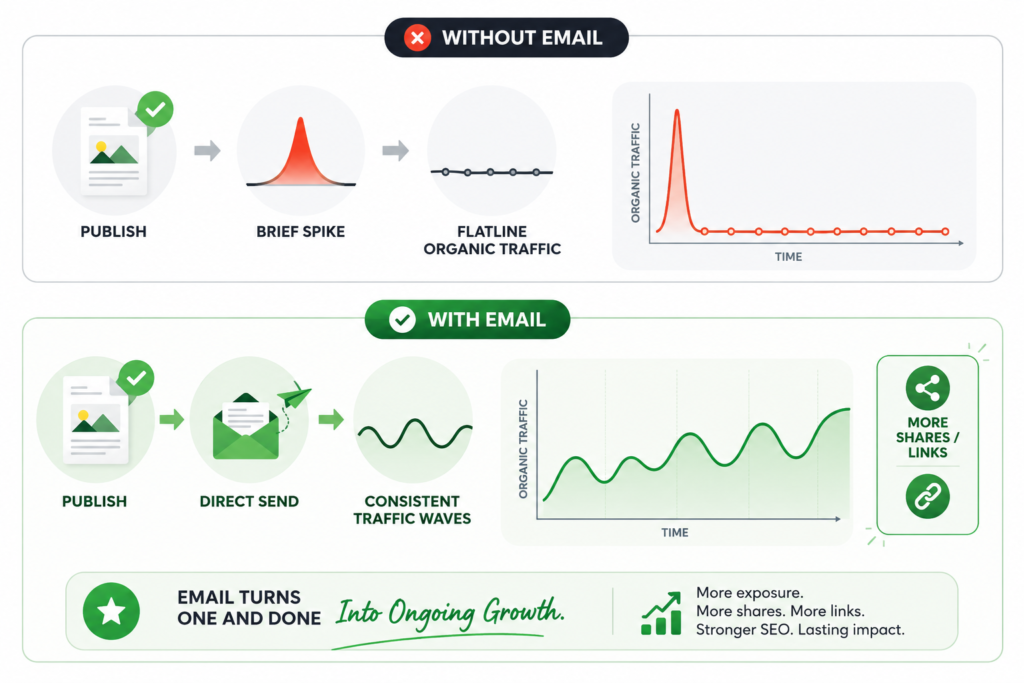
This structural change in traffic distribution alters the post-publication environment. By ensuring that an article is viewed continuously by an engaged audience, you increase the likelihood of secondary actions that search engines care about.
The core distinction rests on understanding the clear line between cause and effect. Email does not rewrite search algorithms. Email amplifies real-world visibility, and that sustained visibility creates the user actions, brand signals, and networking opportunities that fuel long-term organic growth.
Where Email Marketing Creates Real SEO Value
The actual intersection of email distribution and search optimization becomes obvious when you look closely at how information spreads across the internet. Publishing an authoritative article is only half the battle; if no one knows it exists, it cannot earn the signals required to rank well.
Content Reaches Audiences Instantly
Earning competitive search rankings naturally takes time, sometimes requiring months of indexation, refinement, and authority building. Email marketing completely bypasses this waiting period by allowing brands to place fresh content directly in front of interested readers the minute it goes live.
Large-scale enterprise platforms and media publications use this immediate distribution model daily. They do not publish a critical industry report and simply wait for Google to index it. They immediately feature the resource in their next morning digest, driving thousands of immediate readers to the site and building early behavioral momentum.
Keeping Evergreen Content Functional
A major operational benefit of an email list is the ability to continuously surface older, highly valuable evergreen resources. If you have an exhaustive guide on structural data or asset allocation, it shouldn’t just sit in an archive waiting for searchers to find it.
By placing that proven asset into automated welcome sequences or quarterly educational updates, you keep your best work active. This maximizes the return on your initial content investment, ensuring that your highest-value pages continue to receive traffic and engagement even during seasonal dips in search volume.
Transforming One-Time Searchers into Returning Visitors
Search engine optimization excels at capturing users at the exact moment they have a specific question. The limitation is that many of those searchers will read your answer, solve their problem, and immediately leave your site without ever remembering your brand name.
An email capture form transforms that fleeting interaction into a permanent relationship. When a search visitor opts into a newsletter, they transition from an anonymous click into an active subscriber, allowing you to bring them back to your site repeatedly through targeted messaging.
Creating Natural Opportunities for Backlink Generation
Inbound links from respected websites remain a fundamental pillar of search engine authority. While emails do not pass link equity themselves, they are incredibly effective tools for putting your data in front of the exact people who control websites.
When a newsletter is sent to an audience that includes researchers, journalists, content creators, and business leaders, your content is placed directly in front of potential linkers. If a creator reads your original study via your newsletter and subsequently references your statistics in their upcoming blog post, that resulting backlink was earned because email solved the initial discovery problem.
Brand Recognition Often Starts Outside Google
An undervalued way that consistent email messaging aids search performance is through the gradual compounding of brand equity. Consider the typical multi-step journey of an online researcher. A user initially discovers your website through a non-branded informational search like capital gains tax strategies. They read the article, find it genuinely useful, and sign up for your weekly financial breakdown.
Over the next several months, your weekly messages appear consistently in their inbox, establishing your business as an accessible, trusted authority in that space. When that user eventually needs to look up a more complex financial topic, they are no longer going to type a generic phrase into a search engine.
They will specifically modify their search to look for your brand:
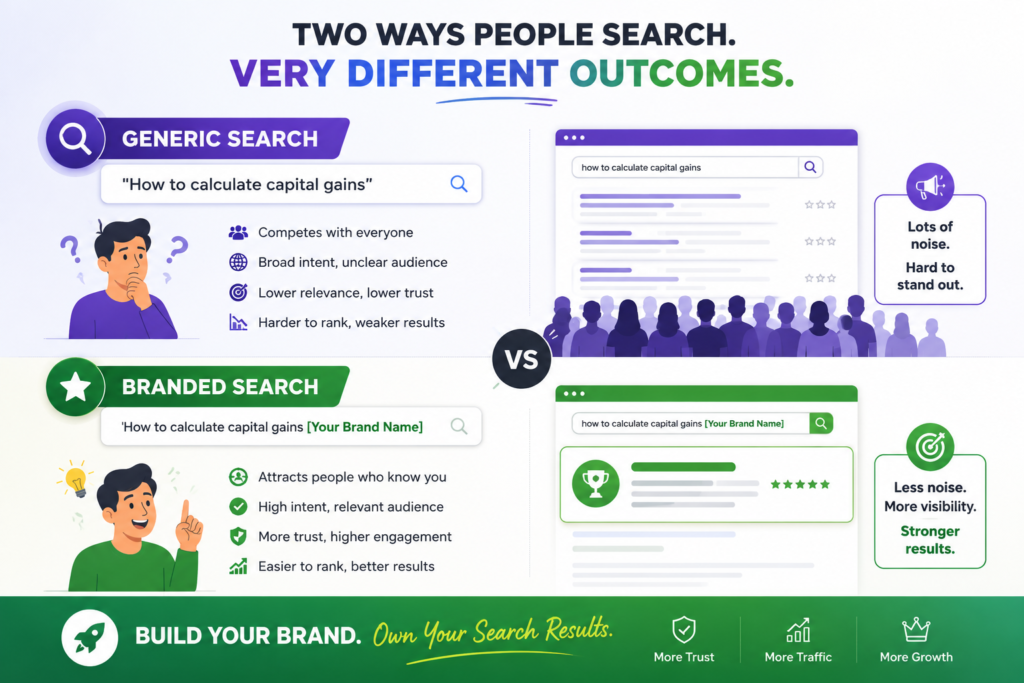
This shift toward branded search terms carries immense business value. Branded queries naturally command exceptionally high click-through rates, face minimal competitor interference, and demonstrate to search algorithms that an organization possesses real-world mindshare and direct user trust.
Using Ahrefs to Decide What Deserves Email Promotion
An inefficient but common mistake among content creators is treating every single blog post with identical importance, blasting out a notification for every short update. A sophisticated strategy utilizes search data to identify which assets possess the highest lifetime value, using email to maximize their exposure.
This is where the tactical crossover between a platform like Ahrefs and an email tool becomes operational. Instead of guessing what to include in an automated sequence, you look at your performance data to spot clear opportunities.
An optimization platform answers critical strategic questions:
- Which specific URLs consistently capture the highest percentage of monthly organic traffic?
- Which pages have entered striking distance of the first page but need an extra push?
- What specific content gaps exist that competitors are successfully leveraging?
- Which older, successful pages have recently been updated and deserve a fresh wave of traffic?
If data shows that an in-depth industry guide is ranking on the second page of search results for a high-value keyword, sending a fresh wave of targeted subscriber traffic to that updated page can stimulate the natural sharing, commentary, and linking needed to help it break through to the first page.
A Practical Workflow That Combines SEO and Email Marketing
The most effective marketing operations do not view search optimization as an acquisition team and email as a retention team. They coordinate both into a unified lifecycle loop where each phase naturally feeds into the next.
A clean, repeatable operational loop works through these specific stages:
- Keyword Discovery: Identify high-demand topics and specific user search questions using Ahrefs.
- Content Creation: Build an authoritative, clear resource that comprehensively solves that user intent.
- On-Page Optimization: Configure clean headings, metadata, and internal links for optimal search crawlability.
- Initial Distribution: Broadcast the new piece directly to your relevant email subscriber segments.
- Performance Tracking: Monitor post-launch organic growth, external backlink acquisition, and user engagement.
- Content Refreshes: Update the resource with fresh data, quotes, or insights after twelve months.
- Re-Promotion: Deliver the newly updated version to your newsletter list to kickstart its next lifecycle phase.
This systematic approach treats content as a long-term asset rather than a single-use announcement. It guarantees that your highest-quality work continues to work actively across multiple marketing channels simultaneously.
Where Many Marketers Get It Wrong
Because the relationship between email distribution and search success is entirely indirect, it is incredibly easy for teams to misinterpret data or focus on the wrong goals.
The most common point of failure is assuming that buying massive email lists and driving millions of low-quality clicks to a page will magically force a URL to rank higher on Google. Search engine algorithms do not access private inbox data, and sudden bursts of untargeted traffic that immediately bounce off your page will not improve your organic standing.
Another error is expecting an immediate influx of high-authority backlinks from every single newsletter sent. Email distribution simply solves the problem of visibility; if the page being promoted is just a thin summary or a generic opinion piece without unique data, readers will have no incentive to reference or link to it.
Finally, teams frequently suffer from a single-send mindset, blast-promoting an asset the day it goes live, and then letting it rot in their blog archives forever. High-value evergreen content should be deliberately integrated into automated email tracks so that new subscribers discover it automatically months or years down the line.
Measuring Whether Email Supports Your SEO Strategy
Since you cannot look at a single metric to see an immediate, direct link between an email blast and a keyword ranking, evaluating your success requires looking at broader behavioral patterns inside your analytics platform.
When auditing your performance, track these specific integrated indicators:
- Returning Visitor Volume: Steady growth in the percentage of users returning to your educational resources via email links.
- Branded Search Metrics: An upward trend in Search Console data for queries that pair your brand name with industry topics.
- Natural Link Acquisition: Monitoring whether your promoted guides pick up new, unprompted backlinks in the weeks following a newsletter feature.
- Time on Page: Evaluating whether email subscribers spend significant, high-value time reading your long-form resources compared to cold search traffic.
Success looks like a steady, upward trend across these interconnected metrics. If your email promotions consistently drive qualified visitors who read deeply, share your resources, and return via branded searches, your email list is successfully acting as an accelerator for your organic growth strategy.
Final Thoughts
The intersection highlighted by Ahrefs of how email marketing impacts seo requires moving past simple yes-or-no answers. Email marketing does not serve as a direct search ranking factor; it does not pass technical link equity, and it will not fix a website that suffers from poor technical optimization or low-quality content.
Its true strength lies in its power as an amplification engine. When you pair deep keyword research and optimization with an active, targeted email distribution strategy, you ensure that your best work never relies on a single channel to survive. You use search optimization to discover what your market needs, and you use email marketing to keep your brand at the center of that conversation.
Questions Marketers Frequently Ask
Does email marketing directly improve Google rankings?
No. Email marketing is not an official Google ranking factor. Search engines cannot crawl private inbox content or monitor email engagement metrics, meaning your newsletter open and click rates have zero direct weight in search algorithms.
Can email marketing help earn backlinks?
Yes, but entirely through indirect channels. Distributing your content via email amplifies its visibility among industry professionals, creators, and journalists on your subscriber list, which increases the likelihood that they will naturally link to it in their own upcoming articles.
Should every blog post be included in a newsletter?
Not necessarily. Blasting your list with thin updates or highly time-sensitive minor announcements can cause subscriber fatigue. It is far more effective to prioritize your high-value evergreen resources, original case studies, or deeply detailed topic guides that offer lasting value.
How does Ahrefs support email marketing?
Ahrefs acts entirely as a research and optimization tool rather than an email provider. It helps you discover which of your existing pages have high search demand, which updated resources deserve a fresh promotion wave, and what specific topics are successfully driving traffic for your industry competitors.
Is email better than SEO?
Neither marketing channel replaces the other because they solve entirely different problems. Search engine optimization handles top-of-funnel discovery by connecting your brand with fresh audiences, while email marketing handles retention by keeping those newly acquired visitors deeply engaged over time.